| ![Show Contents]() Franckland History, Family Crest & Coats of Arms Franckland History, Family Crest & Coats of Arms
- Origins Available:
England
Etymology of FrancklandWhat does the name Franckland mean? The Anglo-Saxon name Franckland comes from when the family resided at the francland or freeland. It the surname Franckland originally derived from the Old French word Francland which referred to dweller at the freeland. The surname Franckland is a topographic surname, which was given to a person who resided near a physical feature such as a hill, stream, church, or type of tree. Early Origins of the Franckland familyThe surname Franckland was first found in Yorkshire where they held a family seat from ancient times and were Lords of the manor of Thirkelby in that county. Of note was the Frankland Baronetcy, of Thirkelby (or Thirkleby.) This Baronetage of England, created on 24 December 1660 for William Frankland (c. 1640-1697.) "The name of Frankland has long been established in the western part of the West Riding [of Yorkshire], as at Giggleswick (Wh. C.). Hugh Francklande was a Yorkshire gentleman who contributed £50 for the defence of his country at the time of the expected Spanish invasion of 1588 (Sp.). The name of Franklan occurs in the Hundredorum Rolls, and it seems probable that Frankland is sometimes a corruption of Franklin. There is a Frankland Hall in the North Riding, and the surname is also established there." 1 Early History of the Franckland familyThis web page shows only a small excerpt of our Franckland research. Another 91 words (6 lines of text) covering the years 1531, 1587, 1628, 1629, 1630, 1640, 1665, 1671, 1685, 1697, 1698, 1726, 1747 and 1816 are included under the topic Early Franckland History in all our PDF Extended History products and printed products wherever possible. Franckland Spelling VariationsBefore English spelling was standardized a few hundred years ago, spelling variations of names were a common occurrence. Elements of Latin, French and other languages became incorporated into English through the Middle Ages, and name spellings changed even among the literate. The variations of the surname Franckland include Frankland, Franklands, Franckland, Francklands and many more. Early Notables of the Franckland familyJocosa or Joyce Frankland (1531-1587), an English philanthropist; William Frankland (died 1640), an English politician who sat in the House of Commons from 1628 to 1629 and in 1640.
Richard Frankland (1630-1698) was an English nonconformist from Rathmell, a hamlet in the parish of Giggleswick, Yorkshire. 2
Sir William Frankland, 1st Baronet (c 1640-1697), was English landowner and...
Another 55 words (4 lines of text) are included under the topic Early Franckland Notables in all our PDF Extended History products and printed products wherever possible.
| Franckland migration to Canada | + |
A great wave of immigration to the New World was the result of the enormous political and religious disarray that struck England at that time. Families left for the New World in extremely large numbers. The long journey was the end of many immigrants and many more arrived sick and starving. Still, those who made it were rewarded with an opportunity far greater than they had known at home in England. These emigrant families went on to make significant contributions to these emerging colonies in which they settled. Some of the first North American settlers carried this name or one of its variants: Franckland Settlers in Canada in the 18th Century- Thomas Franckland, who landed in Nova Scotia in 1774
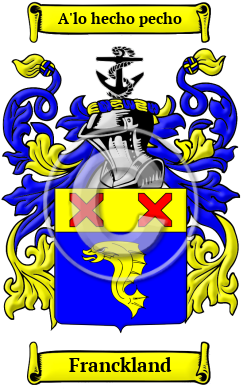
The motto was originally a war cry or slogan. Mottoes first began to be shown with arms in the 14th and 15th centuries, but were not in general use until the 17th century. Thus the oldest coats of arms generally do not include a motto. Mottoes seldom form part of the grant of arms: Under most heraldic authorities, a motto is an optional component of the coat of arms, and can be added to or changed at will; many families have chosen not to display a motto.
Motto: A'lo hecho pecho
- Guppy, Henry Brougham, Homes of Family Names in Great Britain. 1890. Print.
- Smith, George (ed), Dictionary of National Biography. London: Smith, Elder & Co., 1885-1900. Print
 |