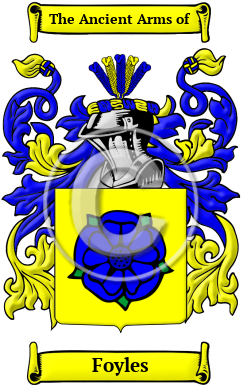
| ![Show Contents]() Foyles History, Family Crest & Coats of Arms Foyles History, Family Crest & Coats of Arms
Etymology of FoylesWhat does the name Foyles mean? The Anglo-Norman Conquest of Ireland lead by Strongbow introduced the first non-Gaelic elements into Irish nomenclature. These Anglo-Normans brought some traditions to Ireland that were not readily found within Gaelic system of hereditary surnames. One of the best examples of this is the local surname. Local surnames, such as Foyles, were taken from the name of a place or a geographical feature where the person lived, held land, or was born. These surnames were very common in England, but were almost non-existent within Ireland previous to the conquest. The earliest surnames of this type came from Normandy, but as the Normans moved, they often created names in reference to where they actually resided. Therefore, some settlers eventually took names from Irish places. Originally, these place names were prefixed by de, which means from in French. This type of prefix was eventually either made a part of the surname, if the place name began with a vowel, or was eliminated entirely. The Foyles family originally lived near a pit, an excavation, or a manmade hollow. The surname Foyles is derived from the Old French word "fouille," which means "pit." This is a derivative of the verb "fouillir," which means "to dig up" or "to excavate." This pit may have been a lime-pit or clay-pit or a hole in to which refuse was thrown. The surname Foyles belongs to the large category of Anglo-Norman habitation names, which are derived from pre-existing names for towns, villages, parishes, or farmsteads. Early Origins of the Foyles familyThe surname Foyles was first found in Hampshire, where they held a family seat from ancient times, some say they were granted lands by William the Conqueror after his conquest of England in 1066, and the name is believed to be derived from the French Fouille, "an excavation." "Though apparently Irish, perhaps through association with the Ulster lough and river and other Irish place-names so called-as a surname Foyle is not Irish in origin, but is derived from the French fouille (excavation) and first appears in mediaeval England as atte Foyle. As Foyle and Foyll it occurs in early Dublin city records at least once in the thirteenth century and quite frequently in the fourteenth, but less often in the fifteenth and sixteenth: throughout that period the family had continuous association with the parish of St. Werburgh's." 1 Early History of the Foyles familyThis web page shows only a small excerpt of our Foyles research. Another 144 words (10 lines of text) covering the years 1172 and 1664 are included under the topic Early Foyles History in all our PDF Extended History products and printed products wherever possible. Foyles Spelling VariationsChurch officials and medieval scribes spelled names as they sounded; therefore, single person, could have his name spelt many different ways during their lifetime. While investigating the origins of the name Foyles, many spelling variations were encountered, including: Foyle, Foile, Foille, Foylle and others. Early Notables of the Foyles familyMore information is included under the topic Early Foyles Notables in all our PDF Extended History products and printed products wherever possible. Migration of the Foyles familyIreland's Great Potato Famine left the country's inhabitants in extreme poverty and starvation. Many families left their homeland for North America for the promise of work, freedom and land ownership. Although the Irish were not free of economic and racial discrimination in North America, they did contribute greatly to the rapid development of bridges, canals, roads, and railways. Eventually, they would be accepted in other areas such as commerce, education, and the arts. An examination of immigration and passenger lists revealed many bearing the name Foyles: Edward Foyle who settled in Philadelphia in 1836; Samuel Foyle settled in Philadelphia in 1873; and John Foyle arrived in Philadelphia in 1877.
- MacLysaght, Edward, Supplement to Irish Families. Baltimore: Genealogical Book Company, 1964. Print.
 |