| ![Show Contents]() Fowers History, Family Crest & Coats of Arms Fowers History, Family Crest & Coats of Arms
- Origins Available:
England
Etymology of FowersWhat does the name Fowers mean? The name Fowers is thought to be a nickname for 'the fowl.' "A West-country form of Fowell and Fowle, a fowl, a bird; compare Vivash and Visick for Fiveash and Fishwick. Especially compare Vowler for Fowler. The genitive of Vowle is Vowles; compare Brooks for Brook, or Williams for William, (a) Bapt. 'the son of Voel,' an ancient Welsh personal name. Just as Hoel became Howell, so Voel has become Vowell. It is probable that, so far as Vowell is concerned, (a) is the chief parent." 1 Early Origins of the Fowers familyThe surname Fowers was first found in Devon where they held the manor of "Fowelscombe, in this parish, the original seat of the Fowel family, created baronets in 1661." 2 Normandy was their origin; of this there is no doubt. "John, Robert, Hugh, Geoffry de Fauvel [were found in] Normandy, 1180-95 (Magni Rotuli Scaccarii Normanniae). William Fauvel held from Oliver de Tracy, Devon, 1165. 3 The name changed to Fauel, Fouel, Voghill, Vowell, and Fowell; the family was seated at Bolters Combe, Devon, and from it descended the Baronets Fowell and the Vowells." 4 The Hundredorum Rolls of 1273 included the following entries all in Oxfordshire: Walter le Fowel; Matthew le Fowel; and John le Fouel. 1 Early History of the Fowers familyThis web page shows only a small excerpt of our Fowers research. Another 227 words (16 lines of text) covering the years 1080, 1091, 1163, 1275, 1399, 1510, 1538, 1578, 1586, 1593, 1598, 1600, 1608, 1609, 1619, 1620, 1623, 1640, 1646, 1648, 1654, 1656, 1659, 1660, 1664, 1665, 1666, 1674, 1677, 1689 and 1692 are included under the topic Early Fowers History in all our PDF Extended History products and printed products wherever possible. Fowers Spelling VariationsSpelling variations in names were a common occurrence before English spelling was standardized a few hundred years ago. In the Middle Ages, even the literate spelled their names differently as the English language incorporated elements of French, Latin, and other European languages. Many variations of the name Fowers have been found, including Fowell, Fowl, Fowall, Fowel, Phowel, Phowell, Vowell, Voules, Vowels, Vowels, Fowls, Fuggle, Foul, Vowl and many more. Early Notables of the Fowers familySir Edmund Fowell, 1st Baronet (1593-1674), an English politician who sat in the House of Commons from 1640 to 1648 and in 1656; Edmund Fowell (c. 1598-1664), an English politician who sat in the House of Commons between 1646 and 1660; Sir John Fowell, 2nd Baronet (1623-1677), an English politician who sat in the House of Commons between 1659 and 1677...
Another 60 words (4 lines of text) are included under the topic Early Fowers Notables in all our PDF Extended History products and printed products wherever possible. Migration of the Fowers familyFamilies began migrating abroad in enormous numbers because of the political and religious discontent in England. Often faced with persecution and starvation in England, the possibilities of the New World attracted many English people. Although the ocean trips took many lives, those who did get to North America were instrumental in building the necessary groundwork for what would become for new powerful nations. Some of the first immigrants to cross the Atlantic and come to North America bore the name Fowers, or a variant listed above: Edmond Fowell, who came to Virginia in 1666; James Fowell, on record in the Windward Islands in 1722; John Fowell, who received a land grant in Virginia in 1666.
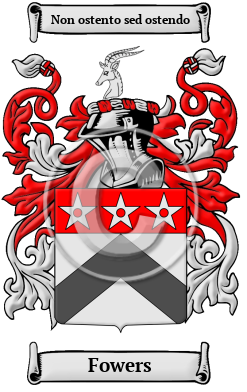
The motto was originally a war cry or slogan. Mottoes first began to be shown with arms in the 14th and 15th centuries, but were not in general use until the 17th century. Thus the oldest coats of arms generally do not include a motto. Mottoes seldom form part of the grant of arms: Under most heraldic authorities, a motto is an optional component of the coat of arms, and can be added to or changed at will; many families have chosen not to display a motto.
Motto: Non ostento sed ostendo
- Bardsley, C.W, A Dictionary of English and Welsh Surnames: With Special American Instances. Wiltshire: Heraldry Today, 1901. Print. (ISBN 0-900455-44-6)
- Worth, R.N., A History of Devonshire London: Elliot Stock, 62, Paternoster Row, E.G., 1895. Digital
- Liber Niger Scutarii ("Black Book of the Exchequer"), containing reports by county on feudal holdings in England in 1166 (reign of Henry II)
- The Norman People and Their Existing Descendants in the British Dominions and the United States Of America. Baltimore: Genealogical Publishing, 1975. Print. (ISBN 0-8063-0636-X)
 |