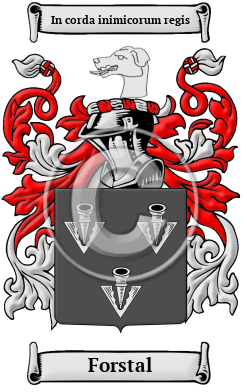
| ![Show Contents]() Forstal History, Family Crest & Coats of Arms Forstal History, Family Crest & Coats of Arms
Etymology of ForstalWhat does the name Forstal mean? The Anglo-Norman Conquest of Ireland lead by Strongbow introduced the first non-Gaelic elements into Irish nomenclature. These Anglo-Normans brought some traditions to Ireland that were not readily found within Gaelic system of hereditary surnames. One of the best examples of this is the local surname. Local surnames, such as Forstal, were taken from the name of a place or a geographical feature where the person lived, held land, or was born. These surnames were very common in England, but were almost non-existent within Ireland previous to the conquest. The earliest surnames of this type came from Normandy, but as the Normans moved, they often created names in reference to where they actually resided. Therefore, some settlers eventually took names from Irish places. Originally, these place names were prefixed by "de," which means "from" in French. This type of prefix was eventually either made a part of the surname, if the place name began with a vowel, or was eliminated entirely. The Forstal family originally lived near a paddock, which is a small grassy enclosed area in which horses can graze and exercise. The surname Forstal is derived from a dialectical word which means paddock. The surname Forstal belongs to the large category of Anglo-Norman habitation names, which are derived from pre-existing names for towns, villages, parishes, or farmsteads. Early Origins of the Forstal familyThe surname Forstal was first found in Kent, where they held a family seat as Lords of the manor of Forstall, and were granted the lands by William the Conqueror for their assistance at the Battle of Hastings in 1066 A.D. Early History of the Forstal familyThis web page shows only a small excerpt of our Forstal research. Another 85 words (6 lines of text) covering the years 1172, 1359 and 1682 are included under the topic Early Forstal History in all our PDF Extended History products and printed products wherever possible. Forstal Spelling VariationsChurch officials and medieval scribes often spelled early surnames as they sounded. This practice often resulted in many spelling variations of even a single name. Early versions of the name Forstal included: Forristal, Forristall, Forrestal, Forrestall, Forrestell, Forestal, Forestel, Forestall, Forestell, Forstal, Forstall, Furstal and many more. Early Notables of the Forstal family- Richard Forstall of Kilkenny
Migration of the Forstal familyIreland went through one of the most devastating periods in its history with the arrival of the Great Potato Famine of the 1840s. Many also lost their lives from typhus, fever and dysentery. And poverty was the general rule as tenant farmers were often evicted because they could not pay the high rents. Emigration to North America gave hundreds of families a chance at a life where work, freedom, and land ownership were all possible. For those who made the long journey, it meant hope and survival. The Irish emigration to British North America and the United States opened up the gates of industry, commerce, education and the arts. Early immigration and passenger lists have shown many Irish people bearing the name Forstal: Richard Forestall who settled in Barbados in 1680; and on the island of Teneriffe; James Forrestill settled in New York state in 1842; James Forrestel landed in New York State in 1842.
The motto was originally a war cry or slogan. Mottoes first began to be shown with arms in the 14th and 15th centuries, but were not in general use until the 17th century. Thus the oldest coats of arms generally do not include a motto. Mottoes seldom form part of the grant of arms: Under most heraldic authorities, a motto is an optional component of the coat of arms, and can be added to or changed at will; many families have chosen not to display a motto.
Motto: In corda inimicorum regis
Motto Translation: In the King's enemies
 |