| ![Show Contents]() Forestal History, Family Crest & Coats of Arms Forestal History, Family Crest & Coats of Arms
Etymology of ForestalWhat does the name Forestal mean? The Anglo-Norman Conquest of Ireland lead by Strongbow introduced the first non-Gaelic elements into Irish nomenclature. These Anglo-Normans brought some traditions to Ireland that were not readily found within Gaelic system of hereditary surnames. One of the best examples of this is the local surname. Local surnames, such as Forestal, were taken from the name of a place or a geographical feature where the person lived, held land, or was born. These surnames were very common in England, but were almost non-existent within Ireland previous to the conquest. The earliest surnames of this type came from Normandy, but as the Normans moved, they often created names in reference to where they actually resided. Therefore, some settlers eventually took names from Irish places. Originally, these place names were prefixed by "de," which means "from" in French. This type of prefix was eventually either made a part of the surname, if the place name began with a vowel, or was eliminated entirely. The Forestal family originally lived near a paddock, which is a small grassy enclosed area in which horses can graze and exercise. The surname Forestal is derived from a dialectical word which means paddock. The surname Forestal belongs to the large category of Anglo-Norman habitation names, which are derived from pre-existing names for towns, villages, parishes, or farmsteads. Early Origins of the Forestal familyThe surname Forestal was first found in Kent, where they held a family seat as Lords of the manor of Forstall, and were granted the lands by William the Conqueror for their assistance at the Battle of Hastings in 1066 A.D. Early History of the Forestal familyThis web page shows only a small excerpt of our Forestal research. Another 85 words (6 lines of text) covering the years 1172, 1359 and 1682 are included under the topic Early Forestal History in all our PDF Extended History products and printed products wherever possible. Forestal Spelling VariationsMedieval scribes and church officials spelled the names as they sounded, so a name was often spelled many different ways during the lifetime of a single person. The investigation of the origin of the name Forestal revealed many spelling variations including Forristal, Forristall, Forrestal, Forrestall, Forrestell, Forestal, Forestel, Forestall, Forestell, Forstal, Forstall, Furstal and many more. Early Notables of the Forestal familyMore information is included under the topic Early Forestal Notables in all our PDF Extended History products and printed products wherever possible.
| Forestal migration to the United States | + |
The Irish emigration during the late 18th and 19th century contributed to the melting pot of nationalities in North America, and the building of a whole new era of industry and commerce in what was seen as a rich, new land. Ireland'sGreat Potato Famine resulted in the worst economic and social conditions in the island's history. And in response to the hunger, disease, and poverty, during this decade the total number of emigrants to leave for North America rivaled all the previous years combined. Those from this decade that arrived on North American shores were not warmly welcomed by the established population, but they were vital to the rapid development of the industry, agriculture, and infrastructure of the infant nations of the United States and what would become Canada. Research into early immigration and passenger lists has shown many people bearing the name Forestal:
Forestal Settlers in United States in the 19th Century- Edmond Forestal, who landed in New Orleans, La in 1813 1
| Forestal migration to Canada | + |
Forestal Settlers in Canada in the 19th Century
| Forestal migration to Australia | + |
Forestal Settlers in Australia in the 19th Century- Michael Forestal, aged 21, who arrived in South Australia in 1857 aboard the ship "Omega"
The motto was originally a war cry or slogan. Mottoes first began to be shown with arms in the 14th and 15th centuries, but were not in general use until the 17th century. Thus the oldest coats of arms generally do not include a motto. Mottoes seldom form part of the grant of arms: Under most heraldic authorities, a motto is an optional component of the coat of arms, and can be added to or changed at will; many families have chosen not to display a motto.
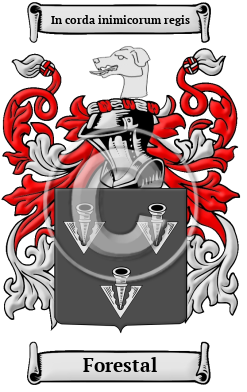
Motto: In corda inimicorum regis
Motto Translation: In the King's enemies
- Filby, P. William, Meyer, Mary K., Passenger and immigration lists index : a guide to published arrival records of about 500,000 passengers who came to the United States and Canada in the seventeenth, eighteenth, and nineteenth centuries. 1982-1985 Cumulated Supplements in Four Volumes Detroit, Mich. : Gale Research Co., 1985, Print (ISBN 0-8103-1795-8)
- Seary E.R., Family Names of the Island of Newfoundland, Montreal: McGill's-Queen's Universtity Press 1998 ISBN 0-7735-1782-0
 |