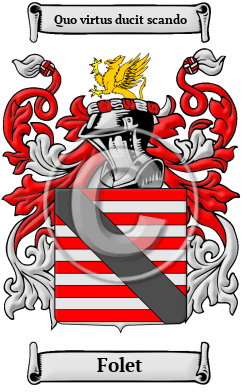
| ![Show Contents]() Folet History, Family Crest & Coats of Arms Folet History, Family Crest & Coats of Arms
Etymology of FoletWhat does the name Folet mean? The Folet surname comes from the Old French word "fol," meaning "mad," or "stupid." This in turn comes from the Latin word "follis" which formerly referred to anything filled with air, but which later took on metaphorical connotation of vanity. As a surname, it was most likely a nickname for a free-spirited or eccentric person, which was later adopted as a hereditary surname. Early Origins of the Folet familyThe surname Folet was first found in Kent where they held a family seat from early times. The earliest record found of the name in Britain, is in the Domesday Book of 1086, which shows a William Folet in Kent. Folet may be descended from a family, which originated in Cotentin, in western Normandy. Of this line was Sampson Foliot, Seigneur, (or Lord) of Montfarville, near Cherbourg. Early History of the Folet familyThis web page shows only a small excerpt of our Folet research. Another 109 words (8 lines of text) covering the years 1100, 1147, 1158 and 1599 are included under the topic Early Folet History in all our PDF Extended History products and printed products wherever possible. Folet Spelling VariationsNorman surnames are characterized by a multitude of spelling variations. The frequent changes in surnames are largely due to the fact that the Old and Middle English languages lacked definite spelling rules. The introduction of Norman French to England, as well as the official court languages of Latin and French, also had pronounced influences on the spelling of surnames. Since medieval scribes and church officials recorded names as they sounded, rather than adhering to any specific spelling rules, it was common to find the same individual referred to with different spellings. The name has been spelled Folet, Follet, Follett and others. Early Notables of the Folet familyMore information is included under the topic Early Folet Notables in all our PDF Extended History products and printed products wherever possible. Migration of the Folet family to IrelandSome of the Folet family moved to Ireland, but this topic is not covered in this excerpt.
Another 33 words (2 lines of text) about their life in Ireland is included in all our PDF Extended History products and printed products wherever possible.
| Folet migration to the United States | + |
Many English families emigrated to North American colonies in order to escape the political chaos in Britain at this time. Unfortunately, many English families made the trip to the New World under extremely harsh conditions. Overcrowding on the ships caused the majority of the immigrants to arrive diseased, famished, and destitute from the long journey across the stormy Atlantic. Despite these hardships, many of the families prospered and went on to make invaluable contributions to the development of the cultures of the United States and Canada. Early North American immigration records have revealed a number of people bearing the name Folet or a variant listed above:
Folet Settlers in United States in the 19th Century- S Folet, who arrived in San Francisco, California in 1851 1
The motto was originally a war cry or slogan. Mottoes first began to be shown with arms in the 14th and 15th centuries, but were not in general use until the 17th century. Thus the oldest coats of arms generally do not include a motto. Mottoes seldom form part of the grant of arms: Under most heraldic authorities, a motto is an optional component of the coat of arms, and can be added to or changed at will; many families have chosen not to display a motto.
Motto: Quo virtus ducit scando
Motto Translation: I climb where virtue leads
- Filby, P. William, Meyer, Mary K., Passenger and immigration lists index : a guide to published arrival records of about 500,000 passengers who came to the United States and Canada in the seventeenth, eighteenth, and nineteenth centuries. 1982-1985 Cumulated Supplements in Four Volumes Detroit, Mich. : Gale Research Co., 1985, Print (ISBN 0-8103-1795-8)
 |