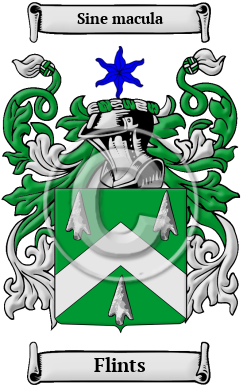
| ![Show Contents]() Flints History, Family Crest & Coats of Arms Flints History, Family Crest & Coats of Arms
Etymology of FlintsWhat does the name Flints mean? The name Flints was spawned by the ancient Anglo-Saxon culture that ruled a majority of Britain. It comes from the personal name Flint. In Old English, patronyms were formed by adding a variety of suffixes to personal names, which changed over time and from place to place. For example, after the Norman Conquest, sunu and sune, which meant son, were the most common patronymic suffixes. In the 12th and 13th centuries, the most common patronymic names included the word filius, which meant son. By the 14th century, the suffix son had replaced these earlier versions. Surnames that were formed with filius or son were more common in the north of England and it was here that the number of individuals without surnames was greatest at this time. Early Origins of the Flints familyThe surname Flints was first found in Suffolk where they held a family seat from very ancient times, and is the name of the great Saxon Gods. The name was recorded in the Domesday Book of 1086. Early History of the Flints familyThis web page shows only a small excerpt of our Flints research. Another 86 words (6 lines of text) covering the years 1290, 1300 and 1379 are included under the topic Early Flints History in all our PDF Extended History products and printed products wherever possible. Flints Spelling VariationsFlints has been spelled many different ways. Before English spelling became standardized over the last few hundred years, spelling variations in names were a common occurrence. As the English language changed in the Middle Ages, absorbing pieces of Latin and French, as well as other languages, the spelling of people's names also changed considerably, even over a single lifetime. Many variations of the name Flints have been found, including Flint, Flinte, Flindt, Flynt and others. Early Notables of the Flints familyMore information is included under the topic Early Flints Notables in all our PDF Extended History products and printed products wherever possible. Migration of the Flints family to IrelandSome of the Flints family moved to Ireland, but this topic is not covered in this excerpt. More information about their life in Ireland is included in all our PDF Extended History products and printed products wherever possible.
| Flints migration to the United States | + |
In an attempt to escape the chaos experienced in England, many English families boarded overcrowded and diseased ships sailing for the shores of North America and other British colonies. Those families hardy enough, and lucky enough, to make the passage intact were rewarded with land and a social environment less prone to religious and political persecution. Many of these families became important contributors to the young colonies in which they settled. Early immigration and passenger lists have documented some of the first Flintss to arrive on North American shores:
Flints Settlers in United States in the 17th Century- Hannah Flints, who landed in Maryland in 1665 1
The motto was originally a war cry or slogan. Mottoes first began to be shown with arms in the 14th and 15th centuries, but were not in general use until the 17th century. Thus the oldest coats of arms generally do not include a motto. Mottoes seldom form part of the grant of arms: Under most heraldic authorities, a motto is an optional component of the coat of arms, and can be added to or changed at will; many families have chosen not to display a motto.
Motto: Sine macula
Motto Translation: Without spot.
- Filby, P. William, Meyer, Mary K., Passenger and immigration lists index : a guide to published arrival records of about 500,000 passengers who came to the United States and Canada in the seventeenth, eighteenth, and nineteenth centuries. 1982-1985 Cumulated Supplements in Four Volumes Detroit, Mich. : Gale Research Co., 1985, Print (ISBN 0-8103-1795-8)
 |