
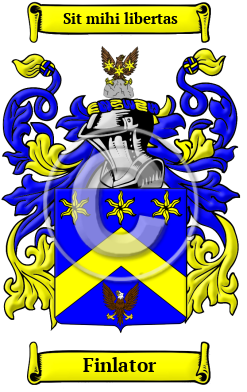
Show ContentsFinlator History, Family Crest & Coats of Arms

Etymology of Finlator

What does the name Finlator mean?

An ancient Pictish-Scottish family was the first to use the name Finlator. It is a name for someone who lived on the lands of Findlater in Banffshire where the family has a long and distinguished history dating back to the early Middle Ages.

Early Origins of the Finlator family

The surname Finlator was first found in Banffshire (Gaelic: Siorrachd Bhanbh), former Scottish county located in the northeasterly Grampian region of Scotland, now of divided between the Council Areas of Moray and Aberdeenshire, where they held a family seat from very ancient times, some say well before the Norman Conquest and the arrival of Duke William at Hastings in 1066 A.D.

Early History of the Finlator family

This web page shows only a small excerpt of our Finlator research. Another 69 words (5 lines of text) covering the year 1366 is included under the topic Early Finlator History in all our PDF Extended History products and printed products wherever possible.

Finlator Spelling Variations

During the Middle Ages, there was no basic set of rules and scribes wrote according to sound. The correct spelling of Scottish names were further compromised after many haphazard translations from Gaelic to English and back. Spelling variations of the name Finlator include Findlater, Finlater, Finlator, Finlaytor, Findlayter and many more.

Early Notables of the Finlator family

More information is included under the topic Early Finlator Notables in all our PDF Extended History products and printed products wherever possible.

Migration of the Finlator family to Ireland

Some of the Finlator family moved to Ireland, but this topic is not covered in this excerpt.
Another 33 words (2 lines of text) about their life in Ireland is included in all our PDF Extended History products and printed products wherever possible.

Migration of the Finlator family

Scots left their country by the thousands to travel to Australia and North America. Desperate for freedom and an opportunity to fend for themselves, many paid huge fees and suffered under terrible conditions on long voyages. Still, for those who made the trip, freedom and opportunity awaited. In North America, many fought their old English oppressors in the American War of Independence. In recent years, Scottish heritage has been an increasingly important topic, as Clan societies and other organizations have renewed people's interest in their history. An examination of passenger and immigration lists shows many early settlers bearing the name of Finlator: William Findlater who settled in Charles Town [Charleston], South Carolina in 1796; Thomas Finlater settled in New Jersey in 1685.


The Finlator Motto +

The motto was originally a war cry or slogan. Mottoes first began to be shown with arms in the 14th and 15th centuries, but were not in general use until the 17th century. Thus the oldest coats of arms generally do not include a motto. Mottoes seldom form part of the grant of arms: Under most heraldic authorities, a motto is an optional component of the coat of arms, and can be added to or changed at will; many families have chosen not to display a motto.

Motto: Sit mihi libertas
Motto Translation: Liberty be mine.


Houseofnames.com on Facebook