| ![Show Contents]() Fiffe History, Family Crest & Coats of Arms Fiffe History, Family Crest & Coats of Arms
- Origins Available:
Scotland
Ireland
Etymology of FiffeWhat does the name Fiffe mean? The Pictish clans of ancient Scotland were the ancestors of first people to use the name Fiffe. The name was found in the county of Fife. The surname Fiffe belongs to the category of habitation names, which are derived from pre-existing names for towns, villages, parishes, or farmsteads. As a general rule, the greater the distance between individuals and their homelands, the larger the territory they were named after. For example, people who only moved to another parish would be known by the name of their original village, while people who migrated to a different country were often known by the name of a region or country from which they came. Early Origins of the Fiffe familyThe surname Fiffe was first found in Fife, where they held a family seat from very ancient times, some say well before the Norman Conquest and the arrival of Duke William at Hastings in 1066 A.D. Early History of the Fiffe familyThis web page shows only a small excerpt of our Fiffe research. Another 181 words (13 lines of text) covering the years 1296, 1436, 1447, 1453, 1454, 1462 and 1464 are included under the topic Early Fiffe History in all our PDF Extended History products and printed products wherever possible. Fiffe Spelling VariationsIn the Middle ages, spelling and translation were not yet regulated by any general rules. spelling variations in names were common even among members of one family unit. Fiffe has appeared Fyfe, Fife, Fyffe, Phyfe, Phyffe and others. Early Notables of the Fiffe familyMore information is included under the topic Early Fiffe Notables in all our PDF Extended History products and printed products wherever possible. Migration of the Fiffe family to IrelandSome of the Fiffe family moved to Ireland, but this topic is not covered in this excerpt. More information about their life in Ireland is included in all our PDF Extended History products and printed products wherever possible.
| Fiffe migration to the United States | + |
Faced by this persecution and the generally unstable political climate of those days, many Scots chose to leave their homeland for Ireland, Australia, and North America in search of greater opportunity and freedom. The colonies across the Atlantic were the most popular choice, but a passage there was neither cheap nor easily suffered. Passengers arrived sick and poor, but those who made it intact often found land and more tolerant societies in which to live. These brave settlers formed the backbone of the burgeoning nations of Canada and the United States. It is only this century that the ancestors of these families have begun to recover their collective identity through the patriotic highland games and Clan societies that have sprung up throughout North America. Research into early immigration and passenger lists revealed many immigrants bearing the name Fiffe:
Fiffe Settlers in United States in the 18th Century- Isac Fiffe, who arrived in Mississippi in 1798 1
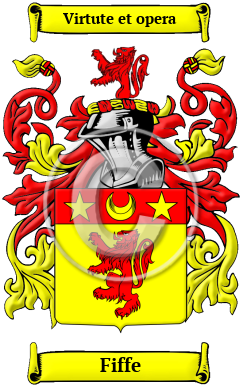
The motto was originally a war cry or slogan. Mottoes first began to be shown with arms in the 14th and 15th centuries, but were not in general use until the 17th century. Thus the oldest coats of arms generally do not include a motto. Mottoes seldom form part of the grant of arms: Under most heraldic authorities, a motto is an optional component of the coat of arms, and can be added to or changed at will; many families have chosen not to display a motto.
Motto: Virtute et opera
Motto Translation: By virtue and energy.
- Filby, P. William, Meyer, Mary K., Passenger and immigration lists index : a guide to published arrival records of about 500,000 passengers who came to the United States and Canada in the seventeenth, eighteenth, and nineteenth centuries. 1982-1985 Cumulated Supplements in Four Volumes Detroit, Mich. : Gale Research Co., 1985, Print (ISBN 0-8103-1795-8)
 |