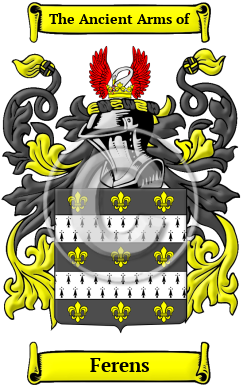
| ![Show Contents]() Ferens History, Family Crest & Coats of Arms Ferens History, Family Crest & Coats of Arms
Etymology of FerensWhat does the name Ferens mean? The rich and ancient history of the Ferens family name dates back to the time of the Anglo-Saxon tribes of Britain. It comes from the given name Farimond. The surname Ferens originally derived from the Old French word Ferrant which meant iron-grey. The surname Ferens was later adopted in England after the Norman Conquest of 1066. In Old English, patronyms were formed by adding a variety of suffixes to personal names, which changed over time and from place to place. For example, after the Norman Conquest, sunu and sune, which meant son, were the most common patronymic suffixes. In the 12th and 13th centuries, the most common patronymic names included the word filius, which meant son. By the 14th century, the suffix son had replaced these earlier versions. Surnames that were formed with filius or son were more common in the north of England and it was here that the number of individuals without surnames was greatest at this time. Early Origins of the Ferens familyThe surname Ferens was first found in the eastern counties of Norfolk, Cambridge and Oxfordshire and it is from this latter shire that we found the first record of the name: Henry Ferant who was listed in the Hundredorum Rolls of 1273. Walter Ferrant was listed in the same census but was found in Cambridgeshire. Finally, the same source lists Benedict Feraunt in Norfolk. 1 Early History of the Ferens familyThis web page shows only a small excerpt of our Ferens research. Another 59 words (4 lines of text) covering the years 1530, 1564, 1569, 1575, 1580, 1600, 1671 and 1890 are included under the topic Early Ferens History in all our PDF Extended History products and printed products wherever possible. Ferens Spelling VariationsSpelling variations in names were a common occurrence before English spelling was standardized a few hundred years ago. In the Middle Ages, even the literate spelled their names differently as the English language incorporated elements of French, Latin, and other European languages. Many variations of the name Ferens have been found, including Farrant, Farrand, Farrin, Farrent, Farren and others. Early Notables of the Ferens familyRichard Farrant (c. 1530-1580), English composer of church music, choirmaster, playwright and theatrical producer who created the Blackfriars Theatre. The date of his first appointment is not known, but he resigned in April, 1564, on becoming Master of the Children of St. George's Chapel, Windsor, of which he is said to have been also a lay vicar and organist. During his tenure of office at Windsor he occupied 'a dwelling house within the Castle, called the Old Commons.' On Nov. 5, 1569, he was re-appointed a...
Another 86 words (6 lines of text) are included under the topic Early Ferens Notables in all our PDF Extended History products and printed products wherever possible. Migration of the Ferens family to IrelandSome of the Ferens family moved to Ireland, but this topic is not covered in this excerpt.
Another 76 words (5 lines of text) about their life in Ireland is included in all our PDF Extended History products and printed products wherever possible.
| Ferens migration to New Zealand | + |
Emigration to New Zealand followed in the footsteps of the European explorers, such as Captain Cook (1769-70): first came sealers, whalers, missionaries, and traders. By 1838, the British New Zealand Company had begun buying land from the Maori tribes, and selling it to settlers, and, after the Treaty of Waitangi in 1840, many British families set out on the arduous six month journey from Britain to Aotearoa to start a new life. Early immigrants include: Ferens Settlers in New Zealand in the 19th Century- Thomas Ferens, aged 25, who arrived in Otago aboard the ship "John Wickliffe" in 1848 2
- Mrs. Ferens, British settler travelling from Gravesend aboard the ship "John Wickliffe" arriving in Port Chalmers, Otago, New Zealand on 23rd March 1848 2
- Mr. Thomas Ferens, British settler travelling from Gravesend aboard the ship "John Wickliffe" arriving in Port Chalmers, Otago, New Zealand on 23rd March 1848 2
- Bardsley, C.W, A Dictionary of English and Welsh Surnames: With Special American Instances. Wiltshire: Heraldry Today, 1901. Print. (ISBN 0-900455-44-6)
- New Zealand Yesteryears Passenger Lists 1800 to 1900 (Retrieved 17th October 2018). Retrieved from http://www.yesteryears.co.nz/shipping/passlist.html
 |