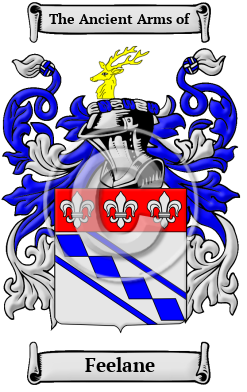
| ![Show Contents]() Feelane History, Family Crest & Coats of Arms Feelane History, Family Crest & Coats of Arms
Etymology of FeelaneWhat does the name Feelane mean? Many variations of the name Feelane have evolved since the time of its initial creation. In Gaelic it appeared as Ó Faoilain, which is derived from the word faol, which means wolf. 1 Early Origins of the Feelane familyThe surname Feelane was first found in County Waterford (Irish: Port Láirge), anciently the Deise region, on the South coast of Ireland in the Province of Munster. Saint Fillan, Foilan or Felan (d. 777?), was an Irish missionary in Scotland in the middle of the eighth century. "His commemoration day in the Scottish calendar is 9 Jan. He was the son of Feredach, a prince in Munster, and Kentigerna, daughter of Kellach Cualann, king of Leinster, and sister to St. Congan. Being thrown into a river on his birth on account of deformity, he was rescued by St. Ibar. He became a monk at first in one of the monasteries of St. Munnu Fintan, and subsequently went from Ireland to the part of Argyll afterwards called Ross, where two churches, Kilkoan and Killellan, derive their names respectively from his uncle Congan and himself. A cave and a church were also named from him in Fife." 2 Early History of the Feelane familyThis web page shows only a small excerpt of our Feelane research. Another 92 words (7 lines of text) covering the years 1172, 1658 and 1680 are included under the topic Early Feelane History in all our PDF Extended History products and printed products wherever possible. Feelane Spelling VariationsPeople who were accounted for by scribes and church officials often had their name recorded many different ways because pronunciation was the only guide those scribes and church officials had to go by. This resulted in the problem of one person's name being recorded under several different variations, creating the illusion of more than one person. Among the many spelling variations of the surname Feelane that are preserved in archival documents are Phelan, O'Phelan, Whelan, O'Failin, Phalen, Phalon, Phaelan and many more. Early Notables of the Feelane familyAnother 33 words (2 lines of text) are included under the topic Early Feelane Notables in all our PDF Extended History products and printed products wherever possible. Migration of the Feelane familyIreland became inhospitable for many native Irish families in the 19th centuries. Poverty, lack of opportunities, high rents, and discrimination forced thousands to leave the island for North America. The largest exodus of Irish settlers occurred with the Great Potato Famine of the late 1840s. For these immigrants the journey to British North America and the United States was long and dangerous and many did not live to see the shores of those new lands. Those who did make it were essential to the development of what would become two of the wealthiest and most powerful nations of the world. These Irish immigrants were not only important for peopling the new settlements and cities, they also provided the manpower needed for the many industrial and agricultural projects so essential to these growing nations. Immigration and passenger lists have documented the arrival of various people bearing the name Feelane to North America: James Phalen settled in South Carolina in 1822; Phillip Phalen settled in Barstable in 1822; Daniel, George, James, John, Michael, Patrick, Thomas, Timothy and William Phelan all arrived in Philadelphia between 1840 and 1860..
- MacLysaght, Edward, Irish Families Their Names, Arms and Origins 4th Edition. Dublin: Irish Academic, 1982. Print. (ISBN 0-7165-2364-7)
- Smith, George (ed), Dictionary of National Biography. London: Smith, Elder & Co., 1885-1900. Print
 |