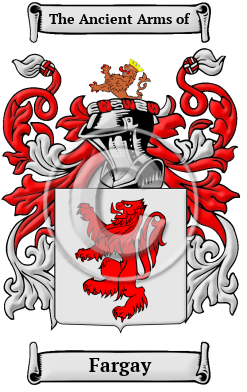
| ![Show Contents]() Fargay History, Family Crest & Coats of Arms Fargay History, Family Crest & Coats of Arms
- Origins Available:
Scotland
Ireland
Etymology of FargayWhat does the name Fargay mean? The ancient Dalriadan clans of Scotland spawned the name Fargay. It is derived from the Scottish surname MacFergus, which means "son of Fergus", which is in turn derived from the Gaelic personal name "Fearghus," composed of the elements "fear," meaning "man," and "gus," meaning "vigor" or "force." This Gaelic name was found early in both Ireland and Scotland. The name is a cognate of with the Cymric "Gwr-gwst," Old Bret. "Urorgost" and the Pictish word "Forcus." This last Pictish form of the name is found on a monument at St. Vigeans in Angus as "Fercos." Fergus I (fl. 330 B.C.?), "son of Ferchard, was the first king of Scotland, according to the fictitious chronology of Boece and Buchanan, is said to have come to Scotland from Ireland about 330 B.C. to assist the Scots already settled in Scotland against the joint attack of the Picts and Britons. After succeeding in this he is further said to have gone back to Ireland to quell disturbances which had arisen in his absence, and to have been drowned in the passage off the rock or port which got the name of Carrick Fergus from him. " 1 Early Origins of the Fargay familyThe surname Fargay was first found in Galloway (Gaelic: Gall-ghaidhealaibh), an area of southwestern Scotland, now part of the Council Area of Dumfries and Galloway, that formerly consisted of the counties of Wigtown (West Galloway) and Kirkcudbright (East Galloway), Ireland where St. Fergus (Fergustian) (circa 730 AD) was an Irish bishop, who went to Scotland as a missionary. He settled near Strageath and founded three churches in Strogeth and two in Caithness. It is possible that he was the Fergustus Pictus who went to Rome in 721 AD. According to Irish lore, a family of this name descend from Fergus, Prince of Galloway (d. 1161), who is said to have married a daughter of Henry I of England. Constantine Mac Fergus (d. 820), was King of the Picts, he "acquired the monarchy by the defeat of Conall Mac Taidg (Teige), who was assassinated in 807 by another Conall, son of Aidan, a Dalriad king in Kintyre. " 1 Early History of the Fargay familyThis web page shows only a small excerpt of our Fargay research. Another 148 words (11 lines of text) covering the years 1300, 1466, 1499, 1582, 1626, 1636, 1642 and 1890 are included under the topic Early Fargay History in all our PDF Extended History products and printed products wherever possible. Fargay Spelling VariationsIn the Middle Ages, the translation between Gaelic and English was not a highly developed process. Spelling was not yet standardized, and so, an enormous number of spelling variations appear in records of early Scottish names. Fargay has appeared as Fergus, Fergie, Forgie, Forgus, Ferris, Farris and many more. Early Notables of the Fargay familyAnother 41 words (3 lines of text) are included under the topic Early Fargay Notables in all our PDF Extended History products and printed products wherever possible. Migration of the Fargay family to IrelandSome of the Fargay family moved to Ireland, but this topic is not covered in this excerpt.
Another 70 words (5 lines of text) about their life in Ireland is included in all our PDF Extended History products and printed products wherever possible. Migration of the Fargay familyMany settled along the east coast of what would become the United States and Canada. As the American War of Independence broke out, those who remained loyal to the crown went north to Canada as United Empire Loyalists. The ancestors of all of these hardy Dalriadan-Scottish settlers began to recover their collective history in the 20th century with the advent of the vibrant culture fostered by highland games and Clan societies in North America. Highland games, Clan societies, and other organizations generated much renewed interest in Scottish heritage in the 20th century. The Fargay were among the earliest of the Scottish settlers as immigration passenger lists have shown: Owen Fergus, who settled in Boston in 1739; James Fergus, who arrived in North Carolina in 1740; another James Fergus, who settled in New York in 1774.
- Smith, George (ed), Dictionary of National Biography. London: Smith, Elder & Co., 1885-1900. Print
 |