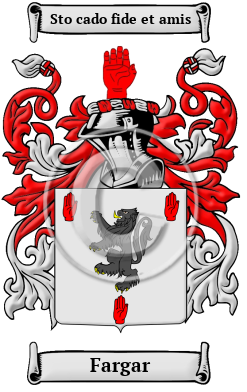
| ![Show Contents]() Fargar History, Family Crest & Coats of Arms Fargar History, Family Crest & Coats of Arms
- Origins Available:
Scotland
Ireland
Etymology of FargarWhat does the name Fargar mean? The chronicles of the Fargar family indicate that the name was first used by the Strathclyde Britons of the Scottish/English Borderlands. Fargar is derived from the Gaelic MacFhearchair which means son of Farquhar and Farquhar is derived from the Gaelic word Fearchar which means very dear one. So, the name means son of the very dear one. 1 2 Early Origins of the Fargar familyThe surname Fargar was first found in Ayrshire (Gaelic: Siorrachd Inbhir Àir), formerly a county in the southwestern Strathclyde region of Scotland, that today makes up the Council Areas of South, East, and North Ayrshire, where they have enjoyed their seat at Kyle Stewart for many generations. The history is quite separate from that of Farquharson. Robert Farquhar, Laird of Gilmilnescroft about the year 1350 was the first Chief on record and he was probably a direct descendant of Ferchart, father of Fergus, one of the chiefs setting the bounds of Newbattle Abbey in 1178. Descended was Ferkar, Earl of Ross, 1224-1231, and at this time a branch was started in the north at Caithness at Ederlarg. 1 Early History of the Fargar familyThis web page shows only a small excerpt of our Fargar research. Another 129 words (9 lines of text) covering the years 1445, 1646, 1677, 1699, 1706, 1707, 1751, 1774, 1813, 1818, 1819, 1823, 1826 and 1839 are included under the topic Early Fargar History in all our PDF Extended History products and printed products wherever possible. Fargar Spelling VariationsThe many spelling variations in Medieval Scottish names result from the fact that scribes in that era spelled words according to sound. Translation too, was an undeveloped science, and many names were altered into complete obscurity. Over the years Fargar has been spelled Farquhar, Farquher, Farker, Farkar, Forker, Farquar, Farquer and many more. Early Notables of the Fargar familyGeorge Farquhar (1677-1707), an Irish dramatist, born in Derry. He is bet known for his Restoration comedy, including his plays The Constant Couple (1699), The Recruiting Officer (1706) and The Beaux' Stratagem (1707).3
John Farquhar (1751-1826) was a Scottish dealer in gunpowder, born of humble parents at Bilbo, in the parish of Crimond, Aberdeenshire who by the time of his death had amassed about £1.5 million.
William Farquhar (1774-1839) was a Scottish colonial administrator...
Another 72 words (5 lines of text) are included under the topic Early Fargar Notables in all our PDF Extended History products and printed products wherever possible. Migration of the Fargar family to IrelandSome of the Fargar family moved to Ireland, but this topic is not covered in this excerpt. More information about their life in Ireland is included in all our PDF Extended History products and printed products wherever possible.
| Fargar migration to the United States | + |
To escape the uncertainties and discrimination faced in Scotland, many decided to head out for North America. Once they arrived, many Scots fought with relish in the American War of Independence; some went north to Canada as United Empire Loyalists. Many ancestors of these Scots have recovered their lost national heritage in the 20th century through Clan organizations and Scottish historical societies. Among the settlers to North America were:
Fargar Settlers in United States in the 18th Century- Thomas, Margeret, his son Thomas and James Fargar, who settled in Charles Town South Carolina in 1767
The motto was originally a war cry or slogan. Mottoes first began to be shown with arms in the 14th and 15th centuries, but were not in general use until the 17th century. Thus the oldest coats of arms generally do not include a motto. Mottoes seldom form part of the grant of arms: Under most heraldic authorities, a motto is an optional component of the coat of arms, and can be added to or changed at will; many families have chosen not to display a motto.
Motto: Sto cado fide et amis
Motto Translation: I stand and fall by faith and arms.
- Black, George F., The Surnames of Scotland Their Origin, Meaning and History. New York: New York Public Library, 1946. Print. (ISBN 0-87104-172-3)
- Smith, Eldson Coles, New Dictionary of American Family Names New York: Harper & Row, 1956. Print
- Smith, George (ed), Dictionary of National Biography. London: Smith, Elder & Co., 1885-1900. Print
 |