| ![Show Contents]() Falde History, Family Crest & Coats of Arms Falde History, Family Crest & Coats of Arms
Etymology of FaldeWhat does the name Falde mean? The Dalriadan kingdom of ancient Scotland was the home of the ancestors of the Falde family. Their name indicates that they lived in the shires of Ayr, Renfrew, Lanark, and Perth, (now part of the Strathclyde region), and there were also lands of East and West Faulds in the lordship of Dudop or Dudhope near Dundee. 1 The surname Faulds is also derived from the Old English word falod, or fold, which indicates that the original bearer of this surname lived by or near an enclosure where cattle were kept. Faulds was also an occupational name for one who worked at the sheep-fold, or for a person who was a shepherd. There is also a place-name Folds in an ancient parish in Bolton, county Lancashire, England. 2 Early Origins of the Falde familyThe surname Falde was first found in Ayrshire (Gaelic: Siorrachd Inbhir Àir), formerly a county in the southwestern Strathclyde region of Scotland, that today makes up the Council Areas of South, East, and North Ayrshire, where they held a family seat from very ancient times. One of the first records of the family is John of Fawls of Leith who imported salmon into London in 1438. Later, Arthur Fauldis held land in Glasgow, 1536, and Archibald Faullis was merchant burgess there, 1642. 1 Early History of the Falde familyThis web page shows only a small excerpt of our Falde research. Another 137 words (10 lines of text) covering the years 1438, 1536, 1642, 1666, 1672, 1674 and 1684 are included under the topic Early Falde History in all our PDF Extended History products and printed products wherever possible. Falde Spelling VariationsTranslation in medieval times was an undeveloped science and was often carried out without due care. For this reason, many early Scottish names appeared radically altered when written in English. The spelling variations of Falde include Faulds, Fawls, Fauldis, Fauls and others. Early Notables of the Falde familyMore information is included under the topic Early Falde Notables in all our PDF Extended History products and printed products wherever possible. Migration of the Falde family to IrelandSome of the Falde family moved to Ireland, but this topic is not covered in this excerpt. More information about their life in Ireland is included in all our PDF Extended History products and printed products wherever possible. Migration of the Falde familyThe descendants of the Dalriadan families who made the great crossing of the Atlantic still dot communities along the east coast of the United States and Canada. In the American War of Independence, many of the settlers traveled north to Canada as United Empire Loyalists. Clan societies and highland games have allowed Canadian and American families of Scottish descent to recover much of their lost heritage. Investigation of the origins of family names on the North American continent has revealed that early immigrants bearing the name Falde or a variant listed above include: Joseph Faulds purchased land in Georgia in 1735. Alexander joined other transplanted Scotsmen in Philadelphia in 1834. Over the next fifty years the Faulds family surname was included among those who made the long trek to San Francisco..
The motto was originally a war cry or slogan. Mottoes first began to be shown with arms in the 14th and 15th centuries, but were not in general use until the 17th century. Thus the oldest coats of arms generally do not include a motto. Mottoes seldom form part of the grant of arms: Under most heraldic authorities, a motto is an optional component of the coat of arms, and can be added to or changed at will; many families have chosen not to display a motto.
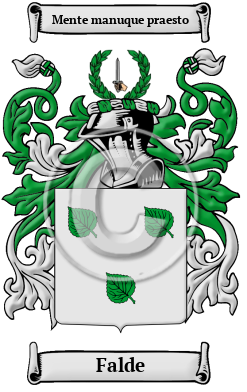
Motto: Mente manuque praesto
Motto Translation: Ready with heart and hand.
- Black, George F., The Surnames of Scotland Their Origin, Meaning and History. New York: New York Public Library, 1946. Print. (ISBN 0-87104-172-3)
- Bardsley, C.W, A Dictionary of English and Welsh Surnames: With Special American Instances. Wiltshire: Heraldry Today, 1901. Print. (ISBN 0-900455-44-6)
 |