| ![Show Contents]() Esses History, Family Crest & Coats of Arms Esses History, Family Crest & Coats of Arms
Etymology of EssesWhat does the name Esses mean? Esses is a name that was carried to England in the great wave of migration from Normandy following the Norman Conquest of 1066. The Esses family lived in close proximity to an ash tree. As such, the name has local references to towns called Ash in Derbyshire, Surrey, Hampshire, and many other places. The variant Aish may have originated at Aish, a hamlet in the English county of Devon, near the village of Stoke Gabriel. Early Origins of the Esses familyThe surname Esses was first found in the county of Devon in southern England. The first person to settle in the locality was D'Esse Court, a companion of King William, Duke of Normandy who landed in England in 1066 A.D. and was granted lands by his liege lord in the vicinity of Exeter, Devon. Alternatively the family could have originated in Esh or Ash, a chapelry, in the parish and union of Lanchester in Durham. "The manor gave name, at a very early period, to a family of considerable local consequence, who held the estate, with little interruption, from the middle of the 13th century till the time of Henry VIII." 1 The Hundredorum Rolls of 1273 list the following: John de le Es, in Norfolk; Roger de le Es, also in Norfolk; Agnes Ate Nasse in Oxfordshire; and Henry de Asse in Warwickshire. 2 The reference "History of Norfolk" list Joan atte-Eshe in 1345, Roger atte-Ashe, temp. Edward II and John at-Ash, of Bintre, Norfolk in 1349. 3 The Yorkshire Poll Tax Rolls of 1379 had only one listing of the family, Robertus del Asch. 2 Another source notes: "There are places so called in Derbyshire, Surrey, Hampshire, and elsewhere. It seems probable, however, that the name was sometimes adopted from residence near a remarkable ash tree. We find the Atten-Ashe of the XIV. cent. contracted into Nashe soon after." 4 Early History of the Esses familyThis web page shows only a small excerpt of our Esses research. Another 108 words (8 lines of text) covering the years 1326, 1597, 1605, 1609, 1618, 1636, 1640, 1644, 1646, 1651, 1652, 1656, 1658, 1660, 1670, 1671, 1681, 1686, 1695, 1697, 1717, 1718, 1735, 1759, 1782 and 1890 are included under the topic Early Esses History in all our PDF Extended History products and printed products wherever possible. Esses Spelling VariationsBefore English spelling was standardized a few hundred years ago, spelling variations of names were a common occurrence. Elements of Latin, Norman French and other languages became incorporated into English throughout the Middle Ages, and name spellings changed even among the literate. The variations of the surname Esses include Esse, Ash, Ashe, Aschey and others. Early Notables of the Esses familyJohn Ashe (1597-1658), an English clothier and politician for Westbury and later for Somerset at various times between 1640 and 1656, upon his death he left a landed estate valued at £6000 a year; Edward Ashe (ca.1609-1656), brother of John Ashe, an English politician who sat in...
Another 47 words (3 lines of text) are included under the topic Early Esses Notables in all our PDF Extended History products and printed products wherever possible. Migration of the Esses family to IrelandSome of the Esses family moved to Ireland, but this topic is not covered in this excerpt.
Another 132 words (9 lines of text) about their life in Ireland is included in all our PDF Extended History products and printed products wherever possible. Migration of the Esses familyIn England at this time, the uncertainty of the political and religious environment of the time caused many families to board ships for distant British colonies in the hopes of finding land and opportunity, and escaping persecution. The voyages were expensive, crowded, and difficult, though, and many arrived in North America sick, starved, and destitute. Those who did make it, however, were greeted with greater opportunities and freedoms that they could have experienced at home. Many of those families went on to make important contributions to the young nations in which they settled. Early immigration records have shown some of the first Essess to arrive on North American shores: Christopher Ash who settled in Virginia in 1623; with his wife and child; Edward Ash settled in Barbados in 1630; George Ash settled in Virginia in 1641.
The motto was originally a war cry or slogan. Mottoes first began to be shown with arms in the 14th and 15th centuries, but were not in general use until the 17th century. Thus the oldest coats of arms generally do not include a motto. Mottoes seldom form part of the grant of arms: Under most heraldic authorities, a motto is an optional component of the coat of arms, and can be added to or changed at will; many families have chosen not to display a motto.
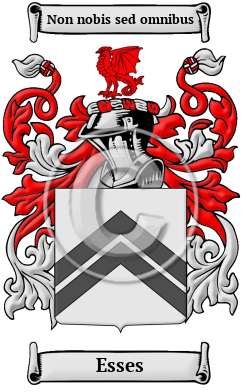
Motto: Non nobis sed omnibus
Motto Translation: Not for us but for all.
- Lewis, Samuel, A Topographical Dictionary of England. Institute of Historical Research, 1848, Print.
- Bardsley, C.W, A Dictionary of English and Welsh Surnames: With Special American Instances. Wiltshire: Heraldry Today, 1901. Print. (ISBN 0-900455-44-6)
- Rye, Walter, A History of Norfolk. London: Elliot Stock, 62, Paternoster Row, 1885. Print
- Lower, Mark Anthony, Patronymica Britannica, A Dictionary of Family Names of the United Kingdom. London: John Russel Smith, 1860. Print.
 |