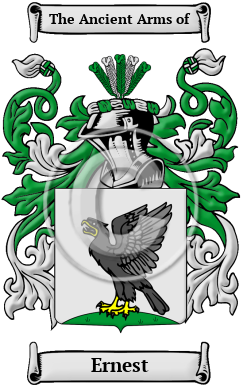
| ![Show Contents]() Ernest History, Family Crest & Coats of Arms Ernest History, Family Crest & Coats of Arms
Early Origins of the Ernest familyThe surname Ernest was first found in Hampshire where they held a family seat as Lords of the Manor. After the Battle of Hastings in 1066, William, Duke of Normandy, having prevailed over King Harold, granted most of Britain to his many victorious Barons. It was not uncommon to find a Baron, or a Bishop, with 60 or more Lordships scattered throughout the country. These he gave to his sons, nephews and other junior lines of his family and they became known as under-tenants. They adopted the Norman system of surnames which identified the under-tenant with his holdings so as to distinguish him from the senior stem of the family. After many rebellious wars between his Barons, Duke William, commissioned a census of all England to determine in 1086, settling once and for all, who held which land. He called the census the Domesday Book, 1 indicating that those holders registered would hold the land until the end of time. Hence, conjecturally, the surname is descended from the tenant of the lands of Winton, held by Waleran Hunter of the Venables family in Normandy who was recorded in the Domesday Book census of 1086. Early Lancashire records show Robert Herneys as holding lands there in the 13th century and later, Phelipot Herneys was found in Bedfordshire in 1337. 2 Early History of the Ernest familyThis web page shows only a small excerpt of our Ernest research. Another 155 words (11 lines of text) covering the years 1068, 1100, 1327, 1510, 1535 and 1600 are included under the topic Early Ernest History in all our PDF Extended History products and printed products wherever possible. Ernest Spelling VariationsMultitudes of spelling variations are a hallmark of Anglo Norman names. Most of these names evolved in the 11th and 12th century, in the time after the Normans introduced their own Norman French language into a country where Old and Middle English had no spelling rules and the languages of the court were French and Latin. To make matters worse, medieval scribes spelled words according to sound, so names frequently appeared differently in the various documents in which they were recorded. The name was spelled Ernies, Erneys, Ernes, Hernes, Hernies, Ernyes, Hernis, Herneys, Ernest, Earnest, Harneys, Harney, Herneys and many more. Early Notables of the Ernest familyMore information is included under the topic Early Ernest Notables in all our PDF Extended History products and printed products wherever possible. Ernest RankingIn the United States, the name Ernest is the 5,500th most popular surname with an estimated 4,974 people with that name. 3
| Ernest migration to the United States | + |
Because of this political and religious unrest within English society, many people decided to immigrate to the colonies. Families left for Ireland, North America, and Australia in enormous numbers, traveling at high cost in extremely inhospitable conditions. The New World in particular was a desirable destination, but the long voyage caused many to arrive sick and starving. Those who made it, though, were welcomed by opportunities far greater than they had known at home in England. Many of these families went on to make important contributions to the emerging nations of Canada and the United States. Analysis of immigration records indicates that some of the first North American immigrants bore the name Ernest or a variant listed above:
Ernest Settlers in United States in the 19th Century- Christian Ernest, who arrived in New York in 1842 4
- Friedrich Ernest, who settled in Texas in 1846
- John Ernest, who landed in Allegany (Allegheny) County, Pennsylvania in 1870 4
- George Ernest, who arrived in Allegany (Allegheny) County, Pennsylvania in 1872 4
| Ernest migration to Canada | + |
Ernest Settlers in Canada in the 19th Century- Cornelius Ernest, who landed in Canada in 1841
| Ernest migration to New Zealand | + |
Emigration to New Zealand followed in the footsteps of the European explorers, such as Captain Cook (1769-70): first came sealers, whalers, missionaries, and traders. By 1838, the British New Zealand Company had begun buying land from the Maori tribes, and selling it to settlers, and, after the Treaty of Waitangi in 1840, many British families set out on the arduous six month journey from Britain to Aotearoa to start a new life. Early immigrants include: Ernest Settlers in New Zealand in the 19th Century- Mr. T. Ernest, British settler travelling from Plymouth aboard the ship "Tongariro" arriving in Auckland, New Zealand in 1887 5
| Contemporary Notables of the name Ernest (post 1700) | + |
- Edward Ernest, American baseball player
- Roy H. Ernest, American Democratic Party politician, Candidate for New York State Senate 47th District, 1930 6
- Josephine Ernest, American Democratic Party politician, Alternate Delegate to Democratic National Convention from Oklahoma, 1956 7
- Gifford Ernest, American politician, Farmer-Labor Candidate for U.S. Representative from Illinois at-large, 1920 7
- Benjamin W. Ernest, American Republican politician, Delegate to Republican National Convention from Tennessee, 1932 7
- John Ernest Steinbeck Jr. (1902-1968), renowned American author, who wrote such novels as "Of Mice and Men" (1937) and "The Grapes of Wrath" (1939). He received the Pulitzer Prize in 1940 and the Nobel Prize for Literature in 1960 and the Presidential Medal of Freedom
- Philip Ernest Summerill (1947-2026), English professional footballer who played as a striker in the Football League for Birmingham City, Huddersfield Town, Millwall and Wimbledon
- Charles Ernest Garforth VC (1891-1973), English recipient of the Victoria Cross for his actions under fire on 23 August 1914
- Jim Ernest Vatcher (b. 1966), American former Major League Baseball outfielder who played from 1990 to 1992
| Historic Events for the Ernest family | + |
- John Ernest, (Jack) Wheeler, British crew member aboard the HMS Dorsetshire (1945) when she was struck by air bombers and sunk; he survived the sinking 7
- Williams, Dr Ann. And G.H. Martin, Eds., Domesday Book A Complete Translation. London: Penguin, 1992. Print. (ISBN 0-141-00523-8)
- Reaney, P.H and R.M. Wilson, A Dictionary of English Surnames. London: Routledge, 1991. Print. (ISBN 0-415-05737-X)
- "What are the 5,000 Most Common Last Names in the U.S.?". NameCensus.com, https://namecensus.com/last-names/
- Filby, P. William, Meyer, Mary K., Passenger and immigration lists index : a guide to published arrival records of about 500,000 passengers who came to the United States and Canada in the seventeenth, eighteenth, and nineteenth centuries. 1982-1985 Cumulated Supplements in Four Volumes Detroit, Mich. : Gale Research Co., 1985, Print (ISBN 0-8103-1795-8)
- New Zealand Yesteryears Passenger Lists 1800 to 1900 (Retrieved 26th March 2019). Retrieved from http://www.yesteryears.co.nz/shipping/passlist.html
- The Political Graveyard: Alphabetical Name Index. (Retrieved 2015, October 22) . Retrieved from http://politicalgraveyard.com/alpha/index.html
- Force Z Survivors HMS Dorsetshire Crew List, (Retrieved 2018, February 13th), https://www.forcez-survivors.org.uk/biographies/listdorsetshirecrew.html
 |