| ![Show Contents]() Einsley History, Family Crest & Coats of Arms Einsley History, Family Crest & Coats of Arms
Early Origins of the Einsley familyThe surname Einsley was first found in Nottinghamshire at Annesley, a parish, in the union of Basford, N. division of the wapentake of Broxtow. 1 "But there is probably a north English local origin also. There is also Ansley, a parish in Warwickshire. " 2 Robert de Insula (d. 1283), bishop of Durham, born at Holy Island, apparently of humble parentage may be related to the family, but it is difficult to confirm as "the Lanercost chronicler calls him Robertus de Coquina." 3 But we must look to the aforementioned Nottinghamshire to find one of the first records of the family. For it is there in 1273, the Hundredorum Rolls listed Johannes de Anneslegh. In Yorkshire, Johannes de Andeslay was listed there in the Yorkshire Poll Tax Rills of 1379 and the Placita de Quo Warranto, temp. Edward I-III. includes an entry for John de Annesley, Yorkshire, 20 Edward I (during the twentieth year of Edward I's reign). 2 However, much further to the north in Scotland, William de Hanesley witnessed a charter by Walter, Bishop of Glasgow, between 1208 and 1218. "He is probably William de Anslee, Canon of Glasgow c. 1220. In 1221 Magister Thomas de Aneslei was one of a number appointed to settle a dispute between the monks of Kelso and the bishop of Glasgow, and Sir Aymer de Aynesley was one of the knights appointed to settle the law of the marches in 1249. Two individuals of this name rendered homage in 1296 [to King Edward I of England]: John le fiz Johan de Anesleye of Roxburghshire, and Johan de Anesleye of Crucfut of Lanarkshire. Adam de Aynesleye was juror on an inquisition held at Roxburgh in 1357, and John of Aynesley witnessed a grant of the forest of Eteryk to John Kerre in 1358. In 1377 Robert II granted to William de Aynysley a charter of the lands of Dolfynston in the sheriffdom of Roxburgh forfeited by John de Aynysley his father." 4 Early History of the Einsley familyThis web page shows only a small excerpt of our Einsley research. Another 90 words (6 lines of text) covering the years 1246, 1296, 1493, 1500, 1521, 1766, 1836 and 1838 are included under the topic Early Einsley History in all our PDF Extended History products and printed products wherever possible. Einsley Spelling VariationsThe name Einsley, appeared in many references, and from time to time, the surname was spelt Ainslie, Ainsley, Ansley, Anslie, Aynslie, Aynsley, Aynsly, Aynsle, Ainley, Endlsley and many more. Early Notables of the Einsley familyWilliam de Aynysley, who was granted a charter of the lands of Dolfynston in the sheriffdom of Roxburgh forfeited by John de Aynysley his father. The lands of Dolphingstoun passed, c. 1500, to the Kers of Cessfurd through marriage of Mark Ker with Marjorie Ainslie, daughter and heiress of John Ainslie. "Ralph Aynsle produced a remission for being treasonably associated...
Another 60 words (4 lines of text) are included under the topic Early Einsley Notables in all our PDF Extended History products and printed products wherever possible. Migration of the Einsley familyThe New World beckoned as many of the settlers in Ireland, known as the Scotch/Irish, became disenchanted. They sailed aboard the armada of sailing ships known as the "White Sails" which plied the stormy Atlantic. Some called them, less romantically, the "coffin ships." Amongst the early settlers who could be considered kinsmen of the Einsley family, or who bore a variation of the surname Einsley were Hugh Ainslie who settled in New York City in 1822; George Ainslee, who arrived in America in 1809; John Ainslee, aged 47, arrived in New York in 1812; Hugh Ainsley, arrived in New York in 1825.
| Contemporary Notables of the name Einsley (post 1700) | + |
- Einsley Delmer "Del" Berg (1915-2016), American soldier and union organizer who lived to be 100 years old, veteran of the Spanish Civil War
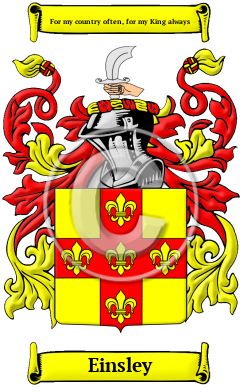
The motto was originally a war cry or slogan. Mottoes first began to be shown with arms in the 14th and 15th centuries, but were not in general use until the 17th century. Thus the oldest coats of arms generally do not include a motto. Mottoes seldom form part of the grant of arms: Under most heraldic authorities, a motto is an optional component of the coat of arms, and can be added to or changed at will; many families have chosen not to display a motto.
Motto: For my country often, for my King always
- Lewis, Samuel, A Topographical Dictionary of England. Institute of Historical Research, 1848, Print.
- Bardsley, C.W, A Dictionary of English and Welsh Surnames: With Special American Instances. Wiltshire: Heraldry Today, 1901. Print. (ISBN 0-900455-44-6)
- Smith, George (ed), Dictionary of National Biography. London: Smith, Elder & Co., 1885-1900. Print
- Black, George F., The Surnames of Scotland Their Origin, Meaning and History. New York: New York Public Library, 1946. Print. (ISBN 0-87104-172-3)
 |