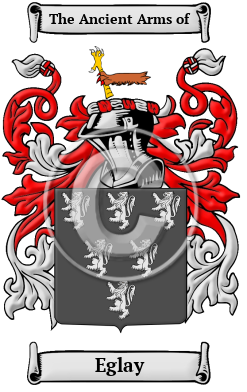
| ![Show Contents]() Eglay History, Family Crest & Coats of Arms Eglay History, Family Crest & Coats of Arms
Etymology of EglayWhat does the name Eglay mean? The name Eglay is rooted in the ancient Norman culture that arrived in England after the Norman Conquest of England in 1066. It was a name for someone who was a person exhibiting characteristics associated with the eagle, such as a lordly or impressive nature, or sharp-eyed vision. The name may also be of toponymic origin and derive from either of two place-names Eagle, in Lincolnshire, 1 or L'Aigle, in Normandy. 2 Another source claims the name is "metaphorically applied to a person of ambitious or soaring disposition." 3 Early Origins of the Eglay familyThe surname Eglay was first found in Lincolnshire where the name dates back to the Domesday Book of 1086 as Aclei or Aycle. 4 Literally the place name means "wood where oak trees grow." 5 However, we must look to Yorkshire to find one of the first record in early rolls, that of Gilbertus de Aquila who was listed there in the Pipe Rolls of 1196. Richer del Egle was found in the Curia Regis Rolls for Northumberland in 1210 and a few years later, Ralph Egle was listed in the Pipe Rolls for Yorkshire in 1230. 6 The Hundredorum Rolls of 1273 record: William Egle, Cambridgeshire; Custance Egke, Cambridgeshire; and Gilbert de la Hegle, Sussex. 7 In Scotland, the family claim descent from the "Norman family of L'Aigle. Matilda de Aquila, 1129, [was] widow of Robert Mowbray, Earl of Northumberland." 8 Early History of the Eglay familyThis web page shows only a small excerpt of our Eglay research. Another 102 words (7 lines of text) covering the years 1129 and 1230 are included under the topic Early Eglay History in all our PDF Extended History products and printed products wherever possible. Eglay Spelling VariationsEndless spelling variations are a prevailing characteristic of Norman surnames. Old and Middle English lacked any definite spelling rules, and the introduction of Norman French added an unfamiliar ingredient to the English linguistic stew. French and Latin, the languages of the court, also influenced spellings. Finally, Medieval scribes generally spelled words according to how they sounded, so one person was often referred to by different spellings in different documents. The name has been spelled Eagle, Eagles, Hegel, Hegell, Aigle, Eagel, Ligle and others. Early Notables of the Eglay familyMore information is included under the topic Early Eglay Notables in all our PDF Extended History products and printed products wherever possible. Migration of the Eglay familyTo escape the political and religious persecution within England at the time, many English families left for the various British colonies abroad. The voyage was extremely difficult, though, and the cramped, dank ships caused many to arrive in the New World diseased and starving. But for those who made it, the trip was most often worth it. Many of the families who arrived went on to make valuable contributions to the emerging nations of Canada and the United States. An inquiry into the early roots of North American families reveals a number of immigrants bearing the name Eglay or a variant listed above: John Eagle who settled in Maryland in 1736; Edward Eagle, who settled in New England in 1763; George Eagle, who settled in Virginia in 1635; Katherine Eagle, who settled in Virginia in 1663.
- Barber, Henry, British Family Names London: Elliot Stock, 62 Paternoster Row, 1894. Print.
- The Norman People and Their Existing Descendants in the British Dominions and the United States Of America. Baltimore: Genealogical Publishing, 1975. Print. (ISBN 0-8063-0636-X)
- Lower, Mark Anthony, Patronymica Britannica, A Dictionary of Family Names of the United Kingdom. London: John Russel Smith, 1860. Print.
- Williams, Dr Ann. And G.H. Martin, Eds., Domesday Book A Complete Translation. London: Penguin, 1992. Print. (ISBN 0-141-00523-8)
- Mills, A.D., Dictionary of English Place-Names. Oxford: Oxford University Press, 1991. Print. (ISBN 0-19-869156-4)
- Reaney, P.H and R.M. Wilson, A Dictionary of English Surnames. London: Routledge, 1991. Print. (ISBN 0-415-05737-X)
- Bardsley, C.W, A Dictionary of English and Welsh Surnames: With Special American Instances. Wiltshire: Heraldry Today, 1901. Print. (ISBN 0-900455-44-6)
- Black, George F., The Surnames of Scotland Their Origin, Meaning and History. New York: New York Public Library, 1946. Print. (ISBN 0-87104-172-3)
 |