
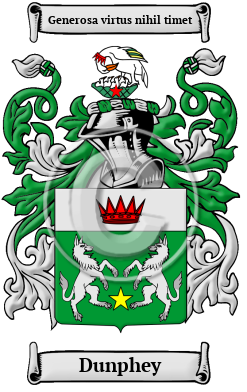
Show ContentsDunphey History, Family Crest & Coats of Arms

Etymology of Dunphey

What does the name Dunphey mean?

There are a multitude of ancient meanings and variations associated with the Irish surnames that are now common throughout the modern world. The original Gaelic form of the name Dunphey is Ó Donnchaidh, which means descendant of Donnchadh, a personal name Anglicized as Donogh.

Early Origins of the Dunphey family

The surname Dunphey was first found in County Kerry (Irish:Ciarraí) part of the former County Desmond (14th-17th centuries), located in Southwestern Ireland, in Munster province, where they held a family seat from very ancient times.

Early History of the Dunphey family

This web page shows only a small excerpt of our Dunphey research. Another 188 words (13 lines of text) covering the years 1014 and 1600 are included under the topic Early Dunphey History in all our PDF Extended History products and printed products wherever possible.

Dunphey Spelling Variations

Irish names recorded during the Middle Ages are characterized by many spelling variations. This preponderance of variations for common names can be explained by the fact that the scribes and church officials that kept records during that period individually decided how to capture one's name. These recorders primarily based their decisions on how the name was pronounced or what it meant. Research into the name Dunphey revealed many variations, including Dunphy, Dunfy, O'Dunphy, O'Donoghue and others.

Early Notables of the Dunphey family

More information is included under the topic Early Dunphey Notables in all our PDF Extended History products and printed products wherever possible.

Migration of the Dunphey family

Under the rule of England, land ownership in Ireland changed dramatically, and many native Irish families found themselves renting out land to farm from absentee owners. This was one of the prime reasons that immigration to North America began in the late 18th century: Irish farmers dreamed of owning their own parcel of land to work for themselves. At this point, the immigrants were at least of modest means for the passage across the Atlantic was often quite dear. In the 1840s the Great Potato Famine created an exodus of people of quite different means. These people were most often destitute: they either sold anything they had to gain a passage or they were sponsored by philanthropic societies. Many of these immigrants were sick from disease and starvation: as a result many did not survive the long transatlantic journey. Although those settlers that did survive were often despised and discriminated against by people already established in these nations, they were critical to rapid development of the powerful industrial nations of the United States and the country that would later become known as Canada. An examination of immigration and passenger lists shows many persons bearing the name of Dunphey or one of its variants: Edward Dunphy in 1772; joined several previous family members who had already settled in Pennsylvania. Other Dunphys were to later join him in Pennsylvania..


The Dunphey Motto +

The motto was originally a war cry or slogan. Mottoes first began to be shown with arms in the 14th and 15th centuries, but were not in general use until the 17th century. Thus the oldest coats of arms generally do not include a motto. Mottoes seldom form part of the grant of arms: Under most heraldic authorities, a motto is an optional component of the coat of arms, and can be added to or changed at will; many families have chosen not to display a motto.

Motto: Generosa virtus nihil timet
Motto Translation: Generous valour fears nothing


Houseofnames.com on Facebook