| ![Show Contents]() Domhnall History, Family Crest & Coats of Arms Domhnall History, Family Crest & Coats of Arms
- Origins Available:
Scotland
Ireland
Etymology of DomhnallWhat does the name Domhnall mean? The Dalriadan clans of ancient Scotland spawned the ancestors of the Domhnall family. Their name comes from a powerful ruler. The name Donald is derived from the Gaelic name Domhnull, or MacDhomhnuill, and the Celtic name Dubnovalos, all of which mean "world ruler" or "world-mighty". The name ranks second only to John in its popularity as a personal name in Scotland. Early Origins of the Domhnall familyThe surname Domhnall was first found in Galloway (Gaelic: Gall-ghaidhealaibh), an area of southwestern Scotland, now part of the Council Area of Dumfries and Galloway, that formerly consisted of the counties of Wigtown (West Galloway) and Kirkcudbright (East Galloway), where they held a family seat from very ancient times, some say well before the Norman Conquest and the arrival of Duke William at Hastings in 1066 A.D. Early History of the Domhnall familyThis web page shows only a small excerpt of our Domhnall research. Another 167 words (12 lines of text) covering the years 1575, 1620, 1703, 1713, 1780 and 1890 are included under the topic Early Domhnall History in all our PDF Extended History products and printed products wherever possible. Domhnall Spelling VariationsThe medieval practice of spelling according to sound and repeated translation between Gaelic and English created many spelling variations of the same name. Domhnall has been recorded as Donald, Donaldson, Doneld, Donnald, Donnaldson and others. Early Notables of the Domhnall familyAdam Donald (1703-1780), called 'the prophet of Bethelnie,' born at the hamlet of that name, twenty miles north of Aberdeen, in 1703. " Notwithstanding his extraordinary stature and build, which caused the country folk to regard him as a changeling 'supernatural in mind as well as in body,' he was unable from some infirmity to labour with his hands, while his parents, struggling peasants, could ill afford to maintain him. Donald had therefore to solve the perplexity of how to live. 'Observing,' says his biographer, 'with what a superstitious veneration the ignorant people around him contemplated that uncouth figure he inherited...
Another 134 words (10 lines of text) are included under the topic Early Domhnall Notables in all our PDF Extended History products and printed products wherever possible. Migration of the Domhnall family to IrelandSome of the Domhnall family moved to Ireland, but this topic is not covered in this excerpt.
Another 91 words (6 lines of text) about their life in Ireland is included in all our PDF Extended History products and printed products wherever possible. Migration of the Domhnall familyDescendents of Dalriadan-Scottish families still populate many communities across North America. They are particularly common in Canada, since many went north as United Empire Loyalists at the time of the American War of Independence. Much later, in the late 19th and early 20th centuries, the highland games and Clan societies that now dot North America sprang up, allowing many Scots to recover their lost national heritage. Some of the first immigrants to cross the Atlantic and come to North America bore the name Domhnall, or a variant listed above: Alexander Donald who settled in Georgia in 1775; Cornelius Donald settled in Maryland in 1776; Mary Donald settled in Pennsylvania in 1773; along with David, and Nash.
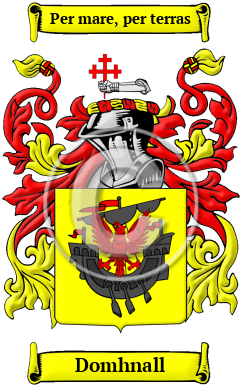
The motto was originally a war cry or slogan. Mottoes first began to be shown with arms in the 14th and 15th centuries, but were not in general use until the 17th century. Thus the oldest coats of arms generally do not include a motto. Mottoes seldom form part of the grant of arms: Under most heraldic authorities, a motto is an optional component of the coat of arms, and can be added to or changed at will; many families have chosen not to display a motto.
Motto: Per mare, per terras
Motto Translation: By sea, by land.
 |