| ![Show Contents]() Derly History, Family Crest & Coats of Arms Derly History, Family Crest & Coats of Arms
Etymology of DerlyWhat does the name Derly mean? The name Derly reached England in the great wave of migration following the Norman Conquest of 1066. The Derly family lived in Derbyshire. They were originally from Erle in Calvados, Normandy, and it is from the local form of this name, D'Erle, which means, from Erle, that their name derives. 1 Alternatively, the name could have originated at Durley, a village and civil parish in the City of Winchester district of Hampshire, England. This village dates back to Saxon times when it was known as Deorleage in 901. 2 By the Domesday Book of 1086, it was called Derleie. 3 Early Origins of the Derly familyThe surname Derly was first found in Derbyshire at Darley, a parish, in the union of Bakewell, partly in the hundred of Wirksworth. Darley Abbey is a historic mill village, now a suburb of the city of Derby and Darley Dale, also known simply as Darley, is a town and civil parish. 4 5 Darley Dale dates back to the Domesday Book of 1086 where it was first listed as Dereleie. 3 Darley Abbey was an Augustinian monastery that dates back to the 12th century when it was first listed as Derega. 2 In the parish of Lastingham, in the North Riding of Yorkshire, the Darley family have been lords of the manor there for a considerable time. 6 A scan of early rolls revealed Warin de Derleg in the Pipe Rolls for Essex in 1200 and William de Derlay the the Yorkshire Poll Tax Rolls of 1379. 4 Another source notes the following in the Hundredorum Rolls of 1273: John de Derleye, Yorkshire; Richard de Derleye, Derbyshire; and Robert de Derleg, Derbyshire. The Yorkshire Poll Tax Rolls of 1379 includes entries for Agnes de Derlay; Nicholaus de Derlegh; and Beatrix de Derlay. 7 Early History of the Derly familyThis web page shows only a small excerpt of our Derly research. Another 122 words (9 lines of text) covering the years 1541, 1559, 1587, 1652, 1689, 1702, 1795, 1798, 1799, 1830, 1846, 1872, 1884 and 1910 are included under the topic Early Derly History in all our PDF Extended History products and printed products wherever possible. Derly Spelling VariationsBefore the advent of the printing press and the first dictionaries, the English language was not standardized. Sound was what guided spelling in the Middle Ages, so one person's name was often recorded under several variations during a single lifetime. Spelling variations were common, even among the names of the most literate people. Known variations of the Derly family name include Darley, Darleigh, Darligh, Darly and others. Early Notables of the Derly familyGeorge Darley (1795-1846), an Irish poet, novelist, and critic; and Thomas Darley of Aldby Park, Yorkshire who in 1702 bought an Arabian horse named Darley Arabian. This horse's bloodline is...
Another 30 words (2 lines of text) are included under the topic Early Derly Notables in all our PDF Extended History products and printed products wherever possible. Migration of the Derly family to IrelandSome of the Derly family moved to Ireland, but this topic is not covered in this excerpt.
Another 239 words (17 lines of text) about their life in Ireland is included in all our PDF Extended History products and printed products wherever possible. Migration of the Derly familyTo escape the political and religious chaos of this era, thousands of English families began to migrate to the New World in search of land and freedom from religious and political persecution. The passage was expensive and the ships were dark, crowded, and unsafe; however, those who made the voyage safely were encountered opportunities that were not available to them in their homeland. Many of the families that reached the New World at this time went on to make important contributions to the emerging nations of the United States and Canada. Research into various historical records has revealed some of first members of the Derly family to immigrate North America: James Darley who settled in Maryland in 1738; Richard and William Darley arrived in Philadelphia in 1854; John and William arrived in Philadelphia in 1798.
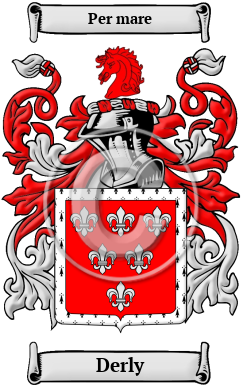
The motto was originally a war cry or slogan. Mottoes first began to be shown with arms in the 14th and 15th centuries, but were not in general use until the 17th century. Thus the oldest coats of arms generally do not include a motto. Mottoes seldom form part of the grant of arms: Under most heraldic authorities, a motto is an optional component of the coat of arms, and can be added to or changed at will; many families have chosen not to display a motto.
Motto: Per mare
Motto Translation: By sea.
- The Norman People and Their Existing Descendants in the British Dominions and the United States Of America. Baltimore: Genealogical Publishing, 1975. Print. (ISBN 0-8063-0636-X)
- Mills, A.D., Dictionary of English Place-Names. Oxford: Oxford University Press, 1991. Print. (ISBN 0-19-869156-4)
- Williams, Dr Ann. And G.H. Martin, Eds., Domesday Book A Complete Translation. London: Penguin, 1992. Print. (ISBN 0-141-00523-8)
- Reaney, P.H and R.M. Wilson, A Dictionary of English Surnames. London: Routledge, 1991. Print. (ISBN 0-415-05737-X)
- Lower, Mark Anthony, Patronymica Britannica, A Dictionary of Family Names of the United Kingdom. London: John Russel Smith, 1860. Print.
- Lewis, Samuel, A Topographical Dictionary of England. Institute of Historical Research, 1848, Print.
- Bardsley, C.W, A Dictionary of English and Welsh Surnames: With Special American Instances. Wiltshire: Heraldry Today, 1901. Print. (ISBN 0-900455-44-6)
 |