| ![Show Contents]() Demestar History, Family Crest & Coats of Arms Demestar History, Family Crest & Coats of Arms
- Origins Available:
Scotland
Ireland
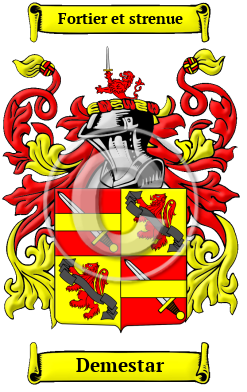
Etymology of DemestarWhat does the name Demestar mean? In ancient Scotland, the Picts were the ancestors of the first to use the name Demestar. It was a name for a person who held the office of judex or dempster to the Parliament. Up until 1747, every barony held courts for trials in that barony and the judex was a baillie for the chief or laird. 1 Demestar Coat of Arms CreationThis is a name derived from Doomster, a judge or executioner. The dempster was of old an honourable officer, and he carried a sword, the Jus gladii. It was the dempster's office to stand at the bar and pronounce the verdict. They have the appropriate crest of a demi-lion holding in his right paw a sword erected, with the motto, " Fortiter et strenue " (Bravely and strenuously). 2 Early Origins of the Demestar familyThe surname Demestar was first found in Perthshire (Gaelic: Siorrachd Pheairt) former county in the present day Council Area of Perth and Kinross, located in central Scotland. "Until the year 1747 every laird whose land had been erected into a barony was empowered to hold courts for the trial and punishment of certain offenders within his barony; and the dempster was part of his retinue. " 3 The first record of the name was "Haldan de Emester of Perthshire, who rendered homage in 1296 [to King Edward I of England], is to be read Haldan Deem ester." 3 His son, or grandson, Haldan Dempster, also inherited the lands of Menemuir. He was a Dempster and held court in that area. Early History of the Demestar familyThis web page shows only a small excerpt of our Demestar research. Another 363 words (26 lines of text) covering the years 1360, 1361, 1364, 1370, 1379, 1388, 1428, 1579, 1585, 1602, 1625, 1684 and 1890 are included under the topic Early Demestar History in all our PDF Extended History products and printed products wherever possible. Demestar Spelling VariationsThe arts of spelling and translation were yet in their infancies when surnames began, so there are an enormous number of spelling variations of the names in early Scottish records. This is a particular problem with Scottish names because of the numerous times a name might have been loosely translated to English from Gaelic and back. Demestar has been spelled Dempster, Deemester, Dempstar, Demster and others. Early Notables of the Demestar familyThomas Dempster (1579-1625), Scottish scholar and historian "was born, according to his own statement, on 23 Aug. 1579. His autobiography, however, is clearly marked by the same habit of grotesquely extravagant falsehood which appears in some of his other writings; and there seems reason to suspect that he may have dated...
Another 51 words (4 lines of text) are included under the topic Early Demestar Notables in all our PDF Extended History products and printed products wherever possible. Migration of the Demestar family to IrelandSome of the Demestar family moved to Ireland, but this topic is not covered in this excerpt.
Another 59 words (4 lines of text) about their life in Ireland is included in all our PDF Extended History products and printed products wherever possible. Migration of the Demestar familyThis oppression forced many Scots to leave their homelands. Most of these chose North America as their destination. Although the journey left many sick and poor, these immigrants were welcomed the hardy with great opportunity. Many of these settlers stood up for their newfound freedom in the American War of Independence. More recently, Scots abroad have recovered much of their collective heritage through highland games and other patriotic functions and groups. An examination of passenger and immigration lists has located various settlers bearing the name Demestar: Jane Dempster who settled in Barbados in 1679; Alex, Blakley, James, John, Lilly, Robert, Samuel and William Dempster, all settled in Philadelphia, Pennsylvania between 1775 and 1868..
The motto was originally a war cry or slogan. Mottoes first began to be shown with arms in the 14th and 15th centuries, but were not in general use until the 17th century. Thus the oldest coats of arms generally do not include a motto. Mottoes seldom form part of the grant of arms: Under most heraldic authorities, a motto is an optional component of the coat of arms, and can be added to or changed at will; many families have chosen not to display a motto.
Motto: Fortier et strenue
Motto Translation: Boldly and earnestly.
- Arthur, William , An Etymological Dictionary of Family and Christian Names. London: 1857. Print
- Polson, Alexander, The Romance of Scottish Crests and Mottoes. Inverness: Walter Alexander, Inglis Street 1929. Print
- Black, George F., The Surnames of Scotland Their Origin, Meaning and History. New York: New York Public Library, 1946. Print. (ISBN 0-87104-172-3)
 |