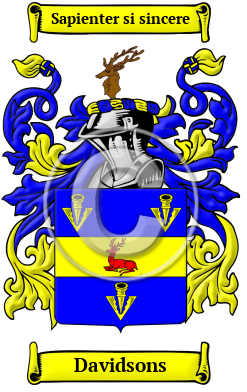
| ![Show Contents]() Davidsons History, Family Crest & Coats of Arms Davidsons History, Family Crest & Coats of Arms
Etymology of DavidsonsWhat does the name Davidsons mean? The history of the ancestors of the Davidsons family begins among the Pictish clans ancient Scotland. The name Davidsons comes from the personal name David. Davidsons is a patronymic surname, which belongs to the category of hereditary surnames. This surname comes from the religious naming tradition, and was adopted from the popular biblical surname, David, which means beloved. This surname is believed to date as far back as the 15th century, BC, and to have come to Scotland from Brittany, with the Picts. The first Chief of the Clan Davidson, David Dubh, was of Pictish descent. He was the fourth son of the chief of Clan Chattan, of which the Davidsons became a part. Early Origins of the Davidsons familyThe surname Davidsons was first found in Perth, where, in 1219, Johnannes filius Davidis, a merchant in Perth, is mentioned. Some accounts suggest that around 1000 AD the Catti (Chattan) Clan, from whom the Davidson Clan descends, broke into two distinct factions, the MacKintosh and the MacPherson Clans. The Davidson Clan was part of the MacPherson element, but always considered itself to be the senior Clan of the Chattan group. Records from the Ragman Rolls show Adami fiz Dauid of Forfarshire and Johan le fiz David of Berwickshire rendering homage to King Edward I of England in 1296. The first estates of the Clan Davidsons were at Invernahaven, a small estate in Badenoch, where they were said to be found from the mid 14th century. Early History of the Davidsons familyThis web page shows only a small excerpt of our Davidsons research. Another 219 words (16 lines of text) covering the years 1396, 1408, 1411, 1466, 1500, 1549, 1603, 1670 and 1890 are included under the topic Early Davidsons History in all our PDF Extended History products and printed products wherever possible. Davidsons Spelling VariationsPrior to the invention of the printing press in the last hundred years, documents were basically unique. Names were written according to sound, and often appeared differently each time they were recorded. Spelling variations of the name Davidsons include Davison, Davidson, Davisint, Davisyn, Debison, Dawysone, Dawyson, Davysone, Davyson, Davitson, Dawysown, Davisoun, Davisend, Davidsone, Davidson, Daveysone, Daveyson, Dauyson, Dawysume, Dauysum and many more. Early Notables of the Davidsons familyAnother 50 words (4 lines of text) are included under the topic Early Davidsons Notables in all our PDF Extended History products and printed products wherever possible. Migration of the Davidsons family to IrelandSome of the Davidsons family moved to Ireland, but this topic is not covered in this excerpt.
Another 80 words (6 lines of text) about their life in Ireland is included in all our PDF Extended History products and printed products wherever possible. Migration of the Davidsons familyThe freedom of the North American colonies was enticing, and many Scots left to make the great crossing. It was a long and hard journey, but its reward was a place where there was more land than people and tolerance was far easier to come by. Many of these people came together to fight for a new nation in the American War of Independence, while others remained loyal to the old order as United Empire Loyalists. The ancestors of Scots in North America have recovered much of this heritage in the 20th century through Clan societies and other such organizations. A search of immigration and passenger lists revealed many important and early immigrants to North America bearing the name of Davidsons: Charles Davidson, who was sent to Virginia in 1666; Elizabeth Davidson, who came to Maryland in 1667; Peter Davidson, who settled in Maryland in 1684; Alexander Davidson, who arrived in Maryland in 1710.
The motto was originally a war cry or slogan. Mottoes first began to be shown with arms in the 14th and 15th centuries, but were not in general use until the 17th century. Thus the oldest coats of arms generally do not include a motto. Mottoes seldom form part of the grant of arms: Under most heraldic authorities, a motto is an optional component of the coat of arms, and can be added to or changed at will; many families have chosen not to display a motto.
Motto: Sapienter si sincere
Motto Translation: Wisely if sincerely.
 |