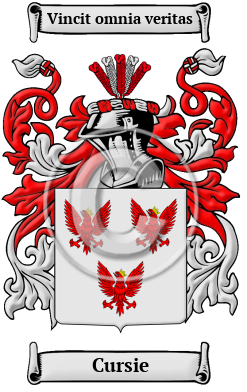
| ![Show Contents]() Cursie History, Family Crest & Coats of Arms Cursie History, Family Crest & Coats of Arms
Etymology of CursieWhat does the name Cursie mean? The Irish already had a system for creating hereditary surnames established when the followers of Strongbow settled in eastern Ireland. Although there was relatively little friction between the two systems because they operated according to very similar principles, the Strongbownians frequently used local surnames. In Ireland, local surnames were almost unheard of, but in England they were probably the most common form of hereditary surname. Local surnames, such as Cursie, were taken from the name of a place or a geographical feature where the person lived, held land, or was born. The surname Cursie is derived from in the settlement of Coursi in Normandy. The surname Cursie belongs to the large category of Anglo-Norman habitation names, which are derived from pre-existing names for towns, villages, parishes, or farmsteads. The Gaelic form of the surname Cursie is de Cúrsa. Early Origins of the Cursie familyThe surname Cursie was first found in County Cork (Irish: Corcaigh) the ancient Kingdom of Deis Muin (Desmond), located on the southwest coast of Ireland in the province of Munster, in Ireland, where this noble family claim descent from Holy Roman Emperor Charlemagne, King of France, who died in 814. Descended was Balderic Teutonicus, Earl of Brion in Normandy, who had six sons. The third son was Robert de Courcy, Lord of Courcy in Normandy. His son, Richard, was at the Battle of Hastings in 1066 A.D. and was granted Stoke-Courcy in Somerset, and other lands. His son John De Courcy, Baron of Stoke Courcy, was created Earl of Ulster by King Henry II for his assistance in conquering the province of Ulster, but Sir John was deprived of his Earldom by King John, who confined him to the Tower of London for one year and granted Ulster to Hugh de Lacie. His son Miles De Courcy, would move to Ireland where he was made the 1st Baron of Kingsale, County Cork. 1 Patrick de Courcy was appointed Justiciar of Ireland in 1221. 2 Early History of the Cursie familyThis web page shows only a small excerpt of our Cursie research. Another 165 words (12 lines of text) covering the years 1098, 1160, 1172, 1176, 1181, 1182, 1210, 1219, 1664 and 1720 are included under the topic Early Cursie History in all our PDF Extended History products and printed products wherever possible. Cursie Spelling VariationsIt was found during an investigation of the origins of the name Cursie that church officials and medieval scribes often spelled the name as it sounded. This practice lead to a single person's being documented under many spelling variations. The name Cursie has existed in the various shapes: Courcy, Courcey, Courcie, Curcy, Cursie, Curcie and many more. Early Notables of the Cursie familySir Richard de Courcy (died 1098) ; John de Courcy (1160-1219), an Anglo-Norman knight who arrived in Ireland in 1176; Affreca de Courcy, was a late 12th century and...
Another 29 words (2 lines of text) are included under the topic Early Cursie Notables in all our PDF Extended History products and printed products wherever possible. Migration of the Cursie familyIrish immigration to North American began in the late 18th century as many Irish families desired to own their own land. This pattern of immigration grew slowly yet steadily until the 1840s. At that time, a failed crop and a growing population in Ireland resulted in the Great Potato Famine. Poverty, disease, and starvation ravaged the land. To ease their pain and suffering the Irish often looked upon North America as a solution: hundreds of thousands undertook the voyage. Their arrival meant the growth of industry and commerce for British North America and the United States. For the individual Irishman, it meant survival and hope, and the opportunity for work, freedom, and ownership of land. The early immigration and passenger lists revealed many bearing the name Cursie: Henry DeCourcy, on record in Maryland in 1634. Others include: William de Courcy, a Jacobite was sent to Maryland in 1763; James Courcey, an enforced emigrant from Ireland to America in 1739.
The motto was originally a war cry or slogan. Mottoes first began to be shown with arms in the 14th and 15th centuries, but were not in general use until the 17th century. Thus the oldest coats of arms generally do not include a motto. Mottoes seldom form part of the grant of arms: Under most heraldic authorities, a motto is an optional component of the coat of arms, and can be added to or changed at will; many families have chosen not to display a motto.
Motto: Vincit omnia veritas
Motto Translation: Truth conquers all things.
- Smith, George (ed), Dictionary of National Biography. London: Smith, Elder & Co., 1885-1900. Print
- Hanks, Patricia and Flavia Hodges, A Dictionary of Surnames. Oxford: Oxford University Press, 1988. Print. (ISBN 0-19-211592-8)
 |