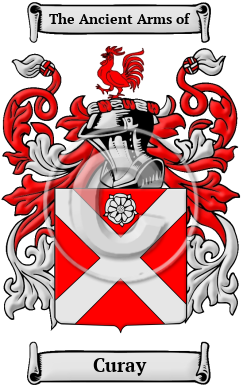
| ![Show Contents]() Curay History, Family Crest & Coats of Arms Curay History, Family Crest & Coats of Arms
Etymology of CurayWhat does the name Curay mean? An ancient Strathclyde-Briton family from the Scottish/English Borderlands were the first to use the name Curay. They lived the place named Currie, derived from Gaelic curraigh, in Midlothian, on record since 1230. Some instances of this name in Scotland are also known to have derived the place name Corrie in Dumfriesshire. Early Origins of the Curay familyThe surname Curay was first found in Midlothian, where "Philip de Curry granted the lands of Dalhengun and Bargower in Kyle to the Abbey of Melrose, 1179. About 1210 Peter de Curri witnessed a charter by Malcolm Loccard, and John Curry of Scotland is mentioned in an Annandale charter, 1238." 1 "Hugh de Corrie witnessed a charter of a fishery in Torduf c. 1194-1211, and as de Corri he witnessed resignation of land in Weremundebi and Anant within the same period. Radulph de Cony witnessed a charter by Henry de Grahame a. 1200." 1 In England, Dodda æt Curi was listed as an Old English Byname in Somerset c1075; and Richard de Cury was listed in Somerset in 1212. 2 Curry, Curry-Mallet, North Curry and Curry-Rivell are all found in Somerset. It is thought that North Curry is the oldest as "this place appears to have been known to the Romans, an urn containing a quantity of silver coins of that people having been discovered in 1748: it was subsequently held by the Saxon kings, and retained in demesne by the Conqueror." 3 Later records show Robert atte Curie in the Subsidy Rolls for Sussex in 1327. 2 Early History of the Curay familyThis web page shows only a small excerpt of our Curay research. Another 544 words (39 lines of text) covering the years 1179, 1243, 1260, 1271, 1274, 1291, 1296, 1330, 1339, 1342, 1362, 1364, 1379, 1398, 1400, 1449, 1506, 1511, 1526, 1528, 1547, 1549, 1570, 1641, 1652, 1689, 1691, 1693, 1780, 1799, 1817, 1820, 1840, 1875 and 1890 are included under the topic Early Curay History in all our PDF Extended History products and printed products wherever possible. Curay Spelling VariationsBefore the printing press standardized spelling in the last few hundred years, no general rules existed in the English language. Spelling variations in Scottish names from the Middle Ages are common even within a single document. Curay has been spelled Currie, Curry, Currey and others. Early Notables of the Curay familySir Frederick Currie (1799-1875), Indian official, third son of Mark Currie of Cobham, Surrey, by Elizabeth, daughter of John Close of Easby, Yorkshire, was born on 3 Feb. 1799. He was educated at Charterhouse and the East India Company's College at Haileybury, and was appointed a cadet in...
Another 48 words (3 lines of text) are included under the topic Early Curay Notables in all our PDF Extended History products and printed products wherever possible. Migration of the Curay family to IrelandSome of the Curay family moved to Ireland, but this topic is not covered in this excerpt.
Another 202 words (14 lines of text) about their life in Ireland is included in all our PDF Extended History products and printed products wherever possible. Migration of the Curay familyFor Scottish immigrants, the great expense of travel to North America did not seem such a problem in those unstable times. Acres of land awaited them and many got the chance to fight for their freedom in the American War of Independence. These Scots and their ancestors went on to play important roles in the forging of the great nations of the United States and Canada. Among them: Charles Currey who settled in Philadelphia in 1851; James Currey settled in St. Christopher in 1716; William and his wife settled in Alexandria Vermont in 1822 with seven children.
- Black, George F., The Surnames of Scotland Their Origin, Meaning and History. New York: New York Public Library, 1946. Print. (ISBN 0-87104-172-3)
- Reaney, P.H and R.M. Wilson, A Dictionary of English Surnames. London: Routledge, 1991. Print. (ISBN 0-415-05737-X)
- Lewis, Samuel, A Topographical Dictionary of England. Institute of Historical Research, 1848, Print.
 |