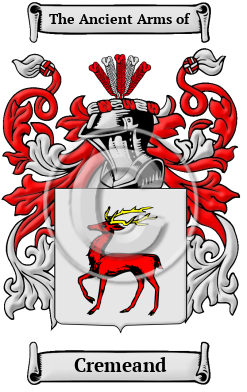
The Cremeand surname is an Anglicized form of the Gaelic Ó Cruimín, which means "descendant of Cruimín," which is derived from the word "crom," meaning "bent," or "crooked."
Loading...
Early Origins of the Cremeand family
The surname Cremeand was first found in County Cork (Irish: Corcaigh) the ancient Kingdom of Deis Muin (Desmond), located on the southwest coast of Ireland in the province of Munster, where they held a family seat from ancient times.
Early History of the Cremeand family
This web page shows only a small excerpt of our Cremeand research. Another 218 words (16 lines of text) covering the years 1446, 1594, 1628, 1640, 1646, 1659, 1665 and 1694 are included under the topic Early Cremeand History in all our PDF Extended History products and printed products wherever possible.
Cremeand Spelling Variations
Lacking standardized spellings, scribes and church officials recorded people's name according to how they sounded. This practice often led to the misleading result of one person's name being recorded under several different spellings. Numerous spelling variations of the surname Cremeand are preserved in the archival documents of the period. The various spellings of the name that were found include Cremin, Crimmin, Cremins, O Cremin, McCremon and others.
Early Notables of the Cremeand family
Charles MacCarty (Cormac Oge McCarthy), (d. 1640). He was from the ancient line of Dermot McCarthy, King of Munster, and was created the 1st Viscount Muskerry in 1628. His motto was "Forti et fideli nihil difficile," which translates as "to... Another 39 words (3 lines of text) are included under the topic Early Cremeand Notables in all our PDF Extended History products and printed products wherever possible.
Loading...
Loading...
Loading...
Loading...
Migration of the Cremeand family
Under the rule of England, land ownership in Ireland changed dramatically, and many native Irish families found themselves renting out land to farm from absentee owners. This was one of the prime reasons that immigration to North America began in the late 18th century: Irish farmers dreamed of owning their own parcel of land to work for themselves. At this point, the immigrants were at least of modest means for the passage across the Atlantic was often quite dear. In the 1840s the Great Potato Famine created an exodus of people of quite different means. These people were most often destitute: they either sold anything they had to gain a passage or they were sponsored by philanthropic societies. Many of these immigrants were sick from disease and starvation: as a result many did not survive the long transatlantic journey. Although those settlers that did survive were often despised and discriminated against by people already established in these nations, they were critical to rapid development of the powerful industrial nations of the United States and the country that would later become known as Canada. An examination of immigration and passenger lists shows many persons bearing the name of Cremeand or one of its variants: Daniel McCarty, who came to Boston in 1742; David McCarty, who settled in Maryland in 1755; Alexander McCarthy, recorded in the New York Colonial Muster Rolls in 1760.