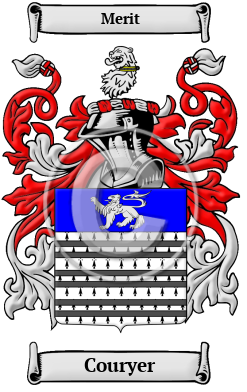
| ![Show Contents]() Couryer History, Family Crest & Coats of Arms Couryer History, Family Crest & Coats of Arms
- Origins Available:
England
Etymology of CouryerWhat does the name Couryer mean? The many generations and branches of the Couryer family can all place the origins of their surname with the ancient Anglo-Saxon culture. Their name reveals that an early member worked as a messenger or person who dresses tanned leather. In the former case, the surname Couryer is derived from the Old French words corëor or courreour, which mean courier. 1 In the latter case, the surname is derived from the Old French word couraieur, which in turn comes from the Old French word conreeur, which means currier. 2 Early Origins of the Couryer familyThe surname Couryer was first found in Yorkshire, where they held a family seat as Lords of the Manor of Kildwick from ancient times. Eluding to the occupational nature of the name, we found Richard le Curer in the Assize Rolls for Northumberland in 1256 and Henry le Coureer in Berkshire in 1281. Maurice le curaour was listed as a Freeman of York in 1293 and further to the south, William le Coureour was recorded in Devon in 1314. 3 William Curreyour, Robert Curreour and John Curreior were found in Colchester in 1375. Back in Yorkshire, Andrew Curier was listed as a Freeman of York in 1400. Robert Curryar was listed in the Feet of Fines for Huntingdonshire in 1546. 3 Early History of the Couryer familyThis web page shows only a small excerpt of our Couryer research. Another 164 words (12 lines of text) covering the years 1220, 1256, 1293, 1314, 1375, 1379, 1400, 1430, 1546, 1656, 1661, 1740, 1813 and 1888 are included under the topic Early Couryer History in all our PDF Extended History products and printed products wherever possible. Couryer Spelling VariationsBefore the last few hundred years, the English language had no fast system of spelling rules. For that reason, spelling variations are commonly found in early Anglo-Saxon surnames. Over the years, many variations of the name Couryer were recorded, including Currer, Curror, Currier, Curryer, Conreor, Couraour, Curur, Curreour, Currour, Curryar, Corour and many more. Early Notables of the Couryer familyNathaniel Currier (1813-1888), co-founder of Currier & Ives, American Lithographers who created famous prints of scenes of 19th century America. Currier was born in Roxbury, Massachusetts and was...
Another 27 words (2 lines of text) are included under the topic Early Couryer Notables in all our PDF Extended History products and printed products wherever possible. Migration of the Couryer familyTo escape oppression and starvation at that time, many English families left for the "open frontiers" of the New World with all its perceived opportunities. In droves people migrated to the many British colonies, those in North America in particular, paying high rates for passages in cramped, unsafe ships. Although many of the settlers did not make the long passage alive, those who did see the shores of North America perceived great opportunities before them. Many of the families that came from England went on to make essential contributions to the emerging nations of Canada and the United States. Research into various historical records revealed some of first members of the Couryer family emigrate to North America: John Currer who arrived in Maryland in 1668.
The motto was originally a war cry or slogan. Mottoes first began to be shown with arms in the 14th and 15th centuries, but were not in general use until the 17th century. Thus the oldest coats of arms generally do not include a motto. Mottoes seldom form part of the grant of arms: Under most heraldic authorities, a motto is an optional component of the coat of arms, and can be added to or changed at will; many families have chosen not to display a motto.
Motto: Merit
Motto Translation: Merit
- Smith, Eldson Coles, New Dictionary of American Family Names New York: Harper & Row, 1956. Print
- Bardsley, C.W, A Dictionary of English and Welsh Surnames: With Special American Instances. Wiltshire: Heraldry Today, 1901. Print. (ISBN 0-900455-44-6)
- Reaney, P.H and R.M. Wilson, A Dictionary of English Surnames. London: Routledge, 1991. Print. (ISBN 0-415-05737-X)
 |