| ![Show Contents]() Corsand History, Family Crest & Coats of Arms Corsand History, Family Crest & Coats of Arms
Etymology of CorsandWhat does the name Corsand mean? An ancient Strathclyde-Briton family from the Scottish/English Borderlands were the first to use the name Corsand. They lived in Dumfriesshire, where the first mention of the family was of Morris Acarson, Bailiff of the Isle of Man, appointed by King Alexander I of Scotland about 1100 A.D. This is the same person as Mauritius Okarefair. 1 The family "was provosts of Dumfries for several generations and were also prominent in local affairs of Kirkcudbrightshire. No value need be attached to the tradition of descent from an Italian named Corsini reputed to have been brought to Scotland by Dervorgilla to superintend the building of Sweetheart Abbey. Everything points to native origin. " 1 Early Origins of the Corsand familyThe surname Corsand was first found in Dumfriesshire (Gaelic: Siorrachd Dhùn Phris), a Southern area, bordering on England that today forms part of the Dumfries and Galloway Council Area, where they are believed to be descended from the Irish Clan MacCarrghama of the Hy Fiachra and arrived on the south west Scottish coast about the 9th century. Sir Robert de Acarson (or de Carsan), a cleric witnessed a charter of Holm Cultram in 1276 and it may be the same Robert de Carsan who rendered homage to Edward I in 1296. 1 "Laughlan, son of Laughlan de Carsan and Dovenald, son of Thomas de Carsan were among some Galloway hostages lodged in Carlisle. In 1305 John Acarson and others took the castle of Dumfries from its garrison. Morice Acrassane and Gilbert were jurors on an inquisition at Drumfrese, 1367." 1 Early History of the Corsand familyThis web page shows only a small excerpt of our Corsand research. Another 270 words (19 lines of text) covering the years 1180, 1296, 1305, 1373, 1374, 1377, 1394, 1445, 1453, 1503, 1531, 1665, 1772, 1776, 1780, 1799, 1808, 1843, 1844, 1850 and 1890 are included under the topic Early Corsand History in all our PDF Extended History products and printed products wherever possible. Corsand Spelling VariationsBefore the printing press standardized spelling in the last few hundred years, no general rules existed in the English language. Spelling variations in Scottish names from the Middle Ages are common even within a single document. Corsand has been spelled Carson, Carsen and others. Early Notables of the Corsand familyAglionby Ross Carson (1780-1850), Scottish classical scholar and rector of the high school of Edinburgh, was born at Holywood, Dumfriesshire.
Alexander Carson (1776-1844), was an Irish Baptist minister, born near Stewartstown, co. Tyrone, in 1776. His parents were Scottish Calvinistic Presbyterians, settled in Ireland, who consecrated their son to the ministry at an early age.
James Carson (1772-1843), was a Scottish physician who was originally educated for the ministry, but his inclination leading him to the study of physic, he attended medical classes at Edinburgh, and graduated doctor of medicine there in the autumn of 1799 (inaugural essay, 'De Viribus quibus Sanguis...
Another 160 words (11 lines of text) are included under the topic Early Corsand Notables in all our PDF Extended History products and printed products wherever possible. Migration of the Corsand family to IrelandSome of the Corsand family moved to Ireland, but this topic is not covered in this excerpt.
Another 129 words (9 lines of text) about their life in Ireland is included in all our PDF Extended History products and printed products wherever possible. Migration of the Corsand familyFor Scottish immigrants, the great expense of travel to North America did not seem such a problem in those unstable times. Acres of land awaited them and many got the chance to fight for their freedom in the American War of Independence. These Scots and their ancestors went on to play important roles in the forging of the great nations of the United States and Canada. Among them: James Carson who arrived in Charles Town [Charleston], South Carolina in 1767 with his wife Jane, son John, and daughters Margaret, Mary, Ann Carson, who was recorded in Philadelphia in 1774.
The motto was originally a war cry or slogan. Mottoes first began to be shown with arms in the 14th and 15th centuries, but were not in general use until the 17th century. Thus the oldest coats of arms generally do not include a motto. Mottoes seldom form part of the grant of arms: Under most heraldic authorities, a motto is an optional component of the coat of arms, and can be added to or changed at will; many families have chosen not to display a motto.
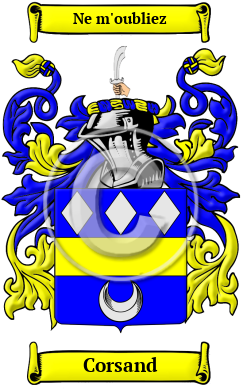
Motto: Ne m'oubliez
Motto Translation: Don't forget me.
- Black, George F., The Surnames of Scotland Their Origin, Meaning and History. New York: New York Public Library, 1946. Print. (ISBN 0-87104-172-3)
 |