| ![Show Contents]() Conant History, Family Crest & Coats of Arms Conant History, Family Crest & Coats of Arms
Etymology of ConantWhat does the name Conant mean? The ancient name Conant is an Old Breton name, originally Conan, which was "the name of Breton chiefs, kings and of a saint; one of the Breton names introduced at the Conquest and common among tenants of the Richmond fee in Lincolnshire and Yorkshire." 1 Another source claims the "surname is derived from the name of an ancestor, 'the son of Conan,' an early legendary name. No doubt more modern representatives of this name would be found in our directories had not Conan as a surname got confused with the more ecclesiastical Cannon or Canon. The final 't' and 'd' in Conant and Conand are, of course, excrescences." 2 Early Origins of the Conant familyThe surname Conant was first found in Lincolnshire where the Latin form Conanus dux Britanniae et comes Richemundie, was recorded a. 1155. A few years later, Henricus filius Conani, Cunani was recorded in the Pipe Rolls for Northumberland in 1196 and later in the Curia Regis Rolls for Yorkshire in 1208. Connand, Conian Gossipe was a Freeman of York (1479-1486) and Robert Connand and Adam Conand were listed in the Yorkshire Poll Tax Rolls of 1319. 1 The source Testa de Nevill, sive Liber Feodorum, temp. Henry III-Edward I. includes an entry for Conan de Kirketun. Lincolnshire, Henry III-Edward I 3. In London, the source Excerpta e Rotulis Finium in Turri Londinensi includes an entry for Conan le Mire, Henry III. 2 The Hundredorum Rolls of 1273 list: Conan Piscator, Lincolnshire; Petronilla Conayn, Lincolnshire; William Conayn, Lincolnshire; and Henry filius Conani, Yorkshire.2 The Yorkshire Poll Tax Rolls of 1379 also included Robert Connand et uxor ejus; Adam Conand; and Conon d'Ask, Yorkshire, 1391. 2 "As a personal name Conan lingered on till the close of the 15th century. It is also interesting to notice that in the two counties (York and Lincoln) where we find the personal namewasonee in use we see the surname flourishing to-day." 2 More recently, the Connant variant is principally found in Devon since the nineteenth century. 4 Early History of the Conant familyThis web page shows only a small excerpt of our Conant research. Another 72 words (5 lines of text) covering the years 1548, 1583, 1592, 1608, 1630, 1638, 1679, 1694, 1775, 1899, 1951, 1954 and 1973 are included under the topic Early Conant History in all our PDF Extended History products and printed products wherever possible. Conant Spelling VariationsSince the Old and Middle English languages lacked definite spelling rules, Breton surnames have many spelling variations. Latin and French, which were the official court languages, were also influential on the spelling of surnames. The spelling of surnames was rarely consistent in medieval times, and scribes and church officials recorded names as they sounded rather than adhering to any specific spelling rules. Therefore, it was common to find the same individual referred to with different spellings of their surname in the ancient chronicles. Moreover, a large number of foreign names were brought into England after the Norman Conquest, which accelerated and accentuated the alterations to the spelling of various surnames. The name has been spelled Conan, Conane, Conad, Connan, Connant, Conant and others. Early Notables of the Conant family- Rev. John Conant (1608-1694), an English clergyman, theologian, and Vice-Chancellor of Oxford University. He was the "son of Robert and Elizabeth Conant, was born at Yettington in the parish of Bicton...
- John Conant, was a yeoman of East Budleigh, Devon. He is considered to be the progenitor of the Devon branch. His son Richard (1548-1630), had eight children including his second son Robert (c. 1583-1...
- Sir Roger Conant, 1st Baronet (1899-1973) was a Conservative Party Member of Parliament (MP) who served as Comptroller of the Household from 1951 to 1954 and was created a Baronet in 1954
Conant RankingIn the United States, the name Conant is the 6,556th most popular surname with an estimated 4,974 people with that name. 5
| Conant migration to the United States | + |
Some of the first immigrants to cross the Atlantic and come to North America carried the name Conant, or a variant listed above:
Conant Settlers in United States in the 17th Century- Roger Conant (c. 1592-1679), born in Devonshire, who landed in Plymouth, Mass aboard the ship "Anne" in 1623, founder of Salem, Massachusetts 7
- Mrs. Sarah Conant, (nee Horton), English settler who arrived in Plymouth, Mass aboard the ship "Anne" in 1623 8
- Christopher Conant, born in Devonshire, brother of Roger, who landed in Plymouth, Mass aboard the ship "Anne" in 1623 7
- Margaret Conant, who arrived in Maryland in 1663 7
- Martha Conant, who landed in Maryland in 1663 7
- ... (More are available in all our PDF Extended History products and printed products wherever possible.)
Conant Settlers in United States in the 19th Century- Samuel Conant, who settled in Nantucket, Massachusetts in 1823
- Mary Conant, aged 25, Irish settler who arrived in New York aboard the ship "Superior" in 1833 9
- Jos Conant, aged 14, Irish settler who arrived in New York aboard the ship "Centurian" in 1849 9
- A. G. Conant, aged 21, British settler who arrived in New York aboard the ship "America" in 1858 9
- Stillmann S. Conant, aged 20, French settler who arrived in New York aboard the ship "Bremen" in 1860 9
- ... (More are available in all our PDF Extended History products and printed products wherever possible.)
Conant Settlers in United States in the 20th Century- Pat. Conant, British settler who arrived in Fremantle, Australia aboard the ship "Ormuz" in 1905 10
- W. D. Conant, British settler who arrived in Fremantle, Australia aboard the ship "Omrah" in 1906 10
- W. L. Conant, British settler who arrived in Fremantle, Australia aboard the ship "Bullara" in 1906 10
- N. Conant, British settler who arrived in Fremantle, Australia aboard the ship "Mongolia" in 1915 10
| Conant migration to Australia | + |
Emigration to Australia included the Second Fleet of convicts, tradespeople and early settlers. Early immigrants include: Second Fleet - Mr. Thomas Conant, (Conans), British settler convicted in Kent, England in 1787, sentenced to 7 years for stealing, transported aboard the ship "Admiral Barrington" leaving in 1790 arriving in New South Wales, Australia in 1791 6
| Contemporary Notables of the name Conant (post 1700) | + |
- James Bryant Conant (1893-1978), American chemist and diplomat, 23rd President of Harvard University, the first U.S. Ambassador to West Germany (1955-1957), recipient of the Presidential Medal of Freedom
- Howell T. Conant (1916-1999), American fashion photographer, best known for his portraits of the the Princess Consort of Monaco, Grace Kelly
- Frederic Warren Conant (1892-1974), American silver medalist sailor at the 1932 Summer Olympics
- Levi Leonard Conant (1857-1916), American mathematician, a specialist in trigonometry, best known for his 1896 book The Number Concept: Its Origin and Development, eponym of the Levi L. Conant Prize
- Kenneth John Conant (1894-1984), American architectural historian
- Marcus Augustine Conant (b. 1936), American dermatologist who was one of the first physicians to diagnose and treat AIDS in 1981
- Jennet Conant (b. 1959), American three-time New York Times Best Seller listed non-fiction author and journalist
- Douglas Conant, American businessman, past President and CEO of the Campbell Soup Company until July 31, 2011
- Scott Conant (b. 1971), American chef, restaurateur, food personality, and cookbook author
- ... (Another 23 notables are available in all our PDF Extended History products and printed products wherever possible.)
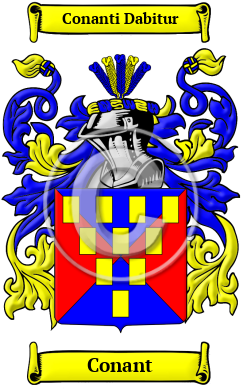
The motto was originally a war cry or slogan. Mottoes first began to be shown with arms in the 14th and 15th centuries, but were not in general use until the 17th century. Thus the oldest coats of arms generally do not include a motto. Mottoes seldom form part of the grant of arms: Under most heraldic authorities, a motto is an optional component of the coat of arms, and can be added to or changed at will; many families have chosen not to display a motto.
Motto: Conanti Dabitur
Motto Translation: It shall be given to him who tries.
- Reaney, P.H and R.M. Wilson, A Dictionary of English Surnames. London: Routledge, 1991. Print. (ISBN 0-415-05737-X)
- Bardsley, C.W, A Dictionary of English and Welsh Surnames: With Special American Instances. Wiltshire: Heraldry Today, 1901. Print. (ISBN 0-900455-44-6)
- Testa de Nevill or "Liber Feodorum" or "Book of Fees," thought to have been written by Ralph de Nevill, for King John (1199–1216)
- Hanks, Patricia and Flavia Hodges, A Dictionary of Surnames. Oxford: Oxford University Press, 1988. Print. (ISBN 0-19-211592-8)
- "What are the 5,000 Most Common Last Names in the U.S.?". NameCensus.com, https://namecensus.com/last-names/
- Convict Records of Australia. Retrieved 4th February 2021 from https://convictrecords.com.au/ships
- Filby, P. William, Meyer, Mary K., Passenger and immigration lists index : a guide to published arrival records of about 500,000 passengers who came to the United States and Canada in the seventeenth, eighteenth, and nineteenth centuries. 1982-1985 Cumulated Supplements in Four Volumes Detroit, Mich. : Gale Research Co., 1985, Print (ISBN 0-8103-1795-8)
- Pilgrim Ship's of 1600's. Retrieved January 6th 2023 from https://www.packrat-pro.com/ships/shiplist.htm
- Ellis Island Passenger Search (Retrieved 24th October 2022).https://heritage.statueofliberty.org/
- National Archives Australia Search (Retrieved 24th October 2022). https://recordsearch.naa.gov.au
 |