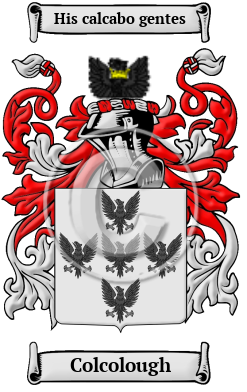
| ![Show Contents]() Colcolough History, Family Crest & Coats of Arms Colcolough History, Family Crest & Coats of Arms
Etymology of ColcoloughWhat does the name Colcolough mean? The name Colcolough is of Anglo-Saxon origin and came from when the family lived in Staffordshire, at Colclough. The place name is a compound of two words, col, meaning cold, and clough, meaning gully. The surname means "dweller near the cold ravine." Early Origins of the Colcolough familyThe surname Colcolough was first found in Staffordshire at Colclough, "an estate in Staffordshire, in which county the family resided, temp. Edward III." 1 "Colecrough, found in the same county, is a manifest variant." 2 "Colclough is the name of an ancient family that resided on the estate of their name at Wolstanton as far back as the reign of Edward III.; the Colcloughs were lords of the manor of Hanley in the 17th century, and members of the family received the honour of knighthood and possessed a baronetcy. The name is still in Hanley." 3 Early History of the Colcolough familyThis web page shows only a small excerpt of our Colcolough research. Another 77 words (6 lines of text) covering the years 1384, 1385, 1386, 1390, 1395, 1397, 1414, 1542, 1575, 1590, 1624, 1628, 1630, 1637, 1650, 1678, 1684, 1687, 1696, 1758 and 1766 are included under the topic Early Colcolough History in all our PDF Extended History products and printed products wherever possible. Colcolough Spelling VariationsIt is only in the last few hundred years that the English language has been standardized. For that reason, early Anglo-Saxon surnames like Colcolough are characterized by many spelling variations. As the English language changed and incorporated elements of other European languages, even literate people changed the spelling of their names. Scribes and monks in the Middle Ages spelled names they sounded, so it is common to find several variations that refer to a single person. The variations of the name Colcolough include: Colclough, Coleclough, Collclough and others. Early Notables of the Colcolough familyWilliam Colclough (died c. 1414), of Newcastle-under-Lyme, Staffordshire and Calverhall, Shropshire, an English politician. He was a Member (MP) of the Parliament of England for Newcastle-under-Lyme in November 1384, 1385, 1386, January 1390, 1395 and January 1397. Caesar Colclough (1696-1766) was a Member of Parliament for County Wexford in the Irish House of Commons.
The Colclough Baronetcy, of Tintern Abbey, County Wexford, was created in the baronetage of Ireland on 21 July 1628 for Adam Colclough, High Sheriff...
Another 76 words (5 lines of text) are included under the topic Early Colcolough Notables in all our PDF Extended History products and printed products wherever possible. Migration of the Colcolough family to IrelandSome of the Colcolough family moved to Ireland, but this topic is not covered in this excerpt.
Another 45 words (3 lines of text) about their life in Ireland is included in all our PDF Extended History products and printed products wherever possible. Migration of the Colcolough familyMany English families tired of political and religious strife left Britain for the new colonies in North America. Although the trip itself offered no relief - conditions on the ships were extremely cramped, and many travelers arrived diseased, starving, and destitute - these immigrants believed the opportunities that awaited them were worth the risks. Once in the colonies, many of the families did indeed prosper and, in turn, made significant contributions to the culture and economies of the growing colonies. An inquiry into the early roots of North American families has revealed a number of immigrants bearing the name Colcolough or a variant listed above: James and Anne Colclough who settled in Delaware in 1772 and later moved to Pennsylvania.
The motto was originally a war cry or slogan. Mottoes first began to be shown with arms in the 14th and 15th centuries, but were not in general use until the 17th century. Thus the oldest coats of arms generally do not include a motto. Mottoes seldom form part of the grant of arms: Under most heraldic authorities, a motto is an optional component of the coat of arms, and can be added to or changed at will; many families have chosen not to display a motto.
Motto: His calcabo gentes
Motto Translation: By these I will trample on the nations.
- Lower, Mark Anthony, Patronymica Britannica, A Dictionary of Family Names of the United Kingdom. London: John Russel Smith, 1860. Print.
- Bardsley, C.W, A Dictionary of English and Welsh Surnames: With Special American Instances. Wiltshire: Heraldry Today, 1901. Print. (ISBN 0-900455-44-6)
- Guppy, Henry Brougham, Homes of Family Names in Great Britain. 1890. Print.
 |