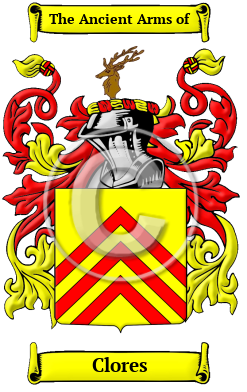
| ![Show Contents]() Clores History, Family Crest & Coats of Arms Clores History, Family Crest & Coats of Arms
Etymology of CloresWhat does the name Clores mean? Clores is a name of ancient Norman origin. It arrived in England with the Norman Conquest of 1066. The Clores family lived in Suffolk. The family was originally from Clere, in Vexin, Normandy. The family de Clare were Norman lords who were descended from Richard fitz Gilbert, who accompanied William the Conqueror into England during the Norman Conquest. The family received huge estates including Clare, now a small town Suffolk; and Tonbridge, now a market town in Kent for their efforts. 1 The parish of St. Cleer in Cornwall is an important location for the family. "The name of this parish is derived from a celebrated female saint called Clare, to whom the church is dedicated, and who is presumed to be its tutelar guardian. She was born of an honourable family in Italy, and having rendered herself famous for the austerity of her manners, she set up a college of virgins, which, after her name were called the order of the Poor Clares of St. Benedict, under the solemn vows of obedience, poverty, and chastity, according to the rule of St. Francis. St. Clare died in the year 1252, aged 70. Now by the death of St. Clare, St. Francis, and St. Benedict, says Hals, may be nearly computed the ages of those churches dedicated to them, and bearing their names in this county. From this parish was denominated an ancient family of gentlemen surnamed De St. Cleare, from whence are descended the St. Cleares of Tudwell, in Devonshire." 2 Early Origins of the Clores familyThe surname Clores was first found in Suffolk where "Richard de Clare (d. 1090) held no less than ninety-five lordships in Suffolk, all attached to his chief lordship of Clare in the same county. To this family we owe the name of an English town, an Irish county, royal dukedom (Clarence), and Cambridge college." 3 Richard fitz Gilbert (d. 1114) was referred to as "Richard of Clare" in the Suffolk return of the Domesday Survey. By the time of the Hundredorum Rolls of 1273, a branch of the family was found in Cambridgeshire as that rolls listed Alan filius Clare as holding lands there at that time. The same rolls also listed: Bogo de Clare in Oxfordshire; Gilbert de Clare in Bedfordshire; Richard de Clara in Somerset; Thomas de Clare in Lincolnshire; and William de Clare in Norfolk. 3 In 1379, the Yorkshire Poll Tax Rolls was complied and it listed the name as both a surname and a forename: Isabella Clare; Clara Dey; and Clare Schepard. 3 Another source confirms the wide migration of the family by the 13th century: "Clare is an ancient Oxfordshire name. In feudal times the De Clares were a very powerful family in southern England. In the 13th century the name of De Clare or De Clar' was established in Oxfordshire, Norfolk, Suffolk, Somerset." 4 Some of the family were found at Waldingham in Surrey in ancient times. "This place appears to be mentioned in Domesday Book under the appellation of Wallingham; it was held at the time of the survey under Richard de Clare, and lands here were possessed by the Clares for some time subsequently." 5 And another branch was found at Yeddingham in the East Riding of Yorkshire. "In 1163, Roger and Helwysia de Clere founded a priory here for nine nuns of the Benedictine order, dedicated to the Virgin Mary." 5 Early History of the Clores familyThis web page shows only a small excerpt of our Clores research. Another 134 words (10 lines of text) covering the years 1100, 1130, 1148, 1153, 1172, 1176, 1217, 1220, 1416, 1453, 1471, 1479, 1511, 1512, 1515, 1529, 1538, 1539, 1545, 1546, 1547, 1557, 1577, 1604, 1605, 1618, 1628, 1677, 1793 and 1864 are included under the topic Early Clores History in all our PDF Extended History products and printed products wherever possible. Clores Spelling VariationsEndless spelling variations are a prevailing characteristic of Norman surnames. Old and Middle English lacked any definite spelling rules, and the introduction of Norman French added an unfamiliar ingredient to the English linguistic stew. French and Latin, the languages of the court, also influenced spellings. Finally, Medieval scribes generally spelled words according to how they sounded, so one person was often referred to by different spellings in different documents. The name has been spelled Clair, Clare, Clere, O'Clear, O'Clair and others. Early Notables of the Clores familyGilbert de Clare, 1st Earl of Pembroke (1100-1148); Richard de Clare, 2nd Earl of Pembroke (1130-1176); and Richard de Clare, 3rd Earl of Hertford (1153-1217.) Isabel de Clare, was the 4th Countess of Pembroke (1172-1220.)
John Clare (1577-1628), was an English Jesuit, born in Wiltshire in 1677, entered the Society of...
Another 49 words (4 lines of text) are included under the topic Early Clores Notables in all our PDF Extended History products and printed products wherever possible. Migration of the Clores family to IrelandSome of the Clores family moved to Ireland, but this topic is not covered in this excerpt.
Another 73 words (5 lines of text) about their life in Ireland is included in all our PDF Extended History products and printed products wherever possible. Migration of the Clores familyTo escape the political and religious persecution within England at the time, many English families left for the various British colonies abroad. The voyage was extremely difficult, though, and the cramped, dank ships caused many to arrive in the New World diseased and starving. But for those who made it, the trip was most often worth it. Many of the families who arrived went on to make valuable contributions to the emerging nations of Canada and the United States. An inquiry into the early roots of North American families reveals a number of immigrants bearing the name Clores or a variant listed above: Nicholas Clare who settled in Barbados in 1678 with his wife and son; John Clare settled in Virginia in 1651; another John settled in Pennsylvania in 1682.
- The Norman People and Their Existing Descendants in the British Dominions and the United States Of America. Baltimore: Genealogical Publishing, 1975. Print. (ISBN 0-8063-0636-X)
- Hutchins, Fortescue, The History of Cornwall, from the Earliest Records and Traditions to the Present Time. London: William Penaluna, 1824. Print
- Bardsley, C.W, A Dictionary of English and Welsh Surnames: With Special American Instances. Wiltshire: Heraldry Today, 1901. Print. (ISBN 0-900455-44-6)
- Guppy, Henry Brougham, Homes of Family Names in Great Britain. 1890. Print.
- Lewis, Samuel, A Topographical Dictionary of England. Institute of Historical Research, 1848, Print.
 |