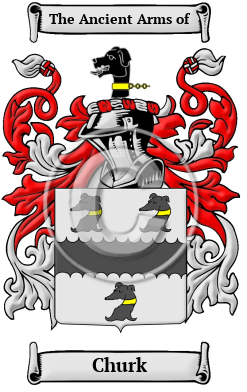
| ![Show Contents]() Churk History, Family Crest & Coats of Arms Churk History, Family Crest & Coats of Arms
Etymology of ChurkWhat does the name Churk mean? The name Churk is of Anglo-Saxon origin and came from when the family lived near a church. The surname Churk is derived from the old English word cyrice, which is itself derived from the Late Greek word kyrikon, which means house of the Lord. 1 2 Churk therefore belongs to the class of topographic surnames, which were given to a person who resided near a physical feature such as a hill, stream, church, or type of tree. The Aglish surname is only found in Ireland where it is one of the few times an English name has been translated into Irish (eaglais, pronounced aglish, Gaelic for a church) Early Origins of the Churk familyThe surname Churk was first found in principally in Somerset but also many counties of England. One of the first records of the name was Thomas Attechurche who was listed in the Subsidy Rolls of Worcester in 1296. The "atte" prefix was quite popular for this surname at that time. Henry atte Churche was listed in the Subsidy Rolls of Sussex in 1368. Henry of the Chirche was listed in 1368. In Norfolk, records there show John Atte-cherch was rector of Metton in 1338. 3 In Somerset, John atte Churche was listed there 1 Edward III (during the first year of the reign of King Edward III.) 4 The Hundredorum Rolls of 1273 list Robert atte Chyrche, Norfolk and later, John Atte-cherch was rector of Metton, Norfolk 1338. 5 "In the 16th century the family of Church or Churche held the manor of Woodham - Mortimer; and in the 17th century, Mr. William Church owned part of the Arnolds estate in Lamborn parish, [Berkshire]." 6 Early History of the Churk familyThis web page shows only a small excerpt of our Churk research. Another 122 words (9 lines of text) covering the years 1273, 1338, 1388, 1572, 1580, 1639, 1659, 1675, 1676, 1718, 1723, 1741, 1890 and 1903 are included under the topic Early Churk History in all our PDF Extended History products and printed products wherever possible. Churk Spelling VariationsIt is only in the last few hundred years that the English language has been standardized. For that reason, early Anglo-Saxon surnames like Churk are characterized by many spelling variations. As the English language changed and incorporated elements of other European languages, even literate people changed the spelling of their names. Scribes and monks in the Middle Ages spelled names they sounded, so it is common to find several variations that refer to a single person. The variations of the name Churk include: Church, Churche, Churchey, Aglish (Ireland) and others. Early Notables of the Churk familyColonel Benjamin Church (c.1639-1718), captain of the first Ranger force in America (1676) and is considered the father of American ranging.
John Church (1675?-1741), was an English musician, "said to have been born at Windsor in 1675, and educated as a chorister at New College, Oxford. " 7 " He obtained also the appointments of lay vicar and master of the choristers of Westminster Abbey. Church composed some anthems and also many songs, which appeared in the collections of the period, and...
Another 81 words (6 lines of text) are included under the topic Early Churk Notables in all our PDF Extended History products and printed products wherever possible. Migration of the Churk family to IrelandSome of the Churk family moved to Ireland, but this topic is not covered in this excerpt.
Another 277 words (20 lines of text) about their life in Ireland is included in all our PDF Extended History products and printed products wherever possible. Migration of the Churk familyMany English families tired of political and religious strife left Britain for the new colonies in North America. Although the trip itself offered no relief - conditions on the ships were extremely cramped, and many travelers arrived diseased, starving, and destitute - these immigrants believed the opportunities that awaited them were worth the risks. Once in the colonies, many of the families did indeed prosper and, in turn, made significant contributions to the culture and economies of the growing colonies. An inquiry into the early roots of North American families has revealed a number of immigrants bearing the name Churk or a variant listed above: Richard Church who settled in Plymouth in the year 1630; who arrived in the fleet with Winthrop in 1630. He was admitted as a freeman of the Colony in 1633. He built the first Church of Dover in 1662. He was taken by Indians, escaped and was finally killed twenty years later by Indians in his own home. Richard Church settled in Virginia in 1630.
- Smith, Eldson Coles, New Dictionary of American Family Names New York: Harper & Row, 1956. Print
- Arthur, William , An Etymological Dictionary of Family and Christian Names. London: 1857. Print
- Reaney, P.H and R.M. Wilson, A Dictionary of English Surnames. London: Routledge, 1991. Print. (ISBN 0-415-05737-X)
- Dickinson, F.H., Kirby's Quest for Somerset of 16th of Edward the 3rd London: Harrison and Sons, Printers in Ordinary to Her Majesty, St, Martin's Lane, 1889. Print.
- Rye, Walter, A History of Norfolk. London: Elliot Stock, 62, Paternoster Row, 1885. Print
- Guppy, Henry Brougham, Homes of Family Names in Great Britain. 1890. Print.
- Smith, George (ed), Dictionary of National Biography. London: Smith, Elder & Co., 1885-1900. Print
 |