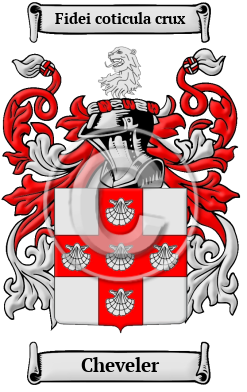
| ![Show Contents]() Cheveler History, Family Crest & Coats of Arms Cheveler History, Family Crest & Coats of Arms
Etymology of ChevelerWhat does the name Cheveler mean? The name Cheveler is Anglo-Saxon in origin. It was a name given to a knight. The surname Cheveler is derived from the Old French word chevalier, which means knight, but horseman and rider are more literal translations. This is derived from the Late Latin word caballarius, which is a derivative of the word caballus, which means horse. 1 In medieval times, only men of wealth could afford the upkeep of a riding horse. In most cases, the surname Cheveler was originally an occupational name applied to a knight's servant, rather than to the knight himself, since most members of the knighthood belonged to noble families which bore surnames derived from their estates. Early Origins of the Cheveler familyThe surname Cheveler was first found in Suffolk, where they held a family seat at Aspal from ancient times. The Hundredorum Rolls of 1273 included: Jordan le Chevaler, Northamptonshire; and Walter le Chevaler, Wiltshire. 2 Early History of the Cheveler familyThis web page shows only a small excerpt of our Cheveler research. Another 223 words (16 lines of text) covering the years 1221, 1273, 1332, 1500, 1540, 1546, 1643, 1661 and 1805 are included under the topic Early Cheveler History in all our PDF Extended History products and printed products wherever possible. Cheveler Spelling VariationsUntil the dictionary, an invention of only the last few hundred years, the English language lacked any comprehensive system of spelling rules. Consequently, spelling variations in names are frequently found in early Anglo-Saxon and later Anglo-Norman documents. One person's name was often spelled several different ways over a lifetime. The recorded variations of Cheveler include Chevalier, Chivaler, Chevaler, Cheveler, Cheualer and others. Early Notables of the Cheveler family- Thomas Cheveler, the Vicar of Stow in Norfolk in the 1540s
Migration of the Cheveler family to IrelandSome of the Cheveler family moved to Ireland, but this topic is not covered in this excerpt. More information about their life in Ireland is included in all our PDF Extended History products and printed products wherever possible. Migration of the Cheveler familyThousands of English families boarded ships sailing to the New World in the hope of escaping the unrest found in England at this time. Although the search for opportunity and freedom from persecution abroad took the lives of many because of the cramped conditions and unsanitary nature of the vessels, the opportunity perceived in the growing colonies of North America beckoned. Many of the settlers who survived the journey went on to make important contributions to the transplanted cultures of their adopted countries. The Cheveler were among these contributors, for they have been located in early North American records: Joseph Chevalier who arrived in New York in 1798.
The motto was originally a war cry or slogan. Mottoes first began to be shown with arms in the 14th and 15th centuries, but were not in general use until the 17th century. Thus the oldest coats of arms generally do not include a motto. Mottoes seldom form part of the grant of arms: Under most heraldic authorities, a motto is an optional component of the coat of arms, and can be added to or changed at will; many families have chosen not to display a motto.
Motto: Fidei coticula crux
Motto Translation: The cross is the test of truth.
- Harrison, Henry, Surnames of the United Kingdom: A Concise Etymological Dictionary Baltimore: Geneological Publishing Company, 2013. Print
- Bardsley, C.W, A Dictionary of English and Welsh Surnames: With Special American Instances. Wiltshire: Heraldry Today, 1901. Print. (ISBN 0-900455-44-6)
 |