
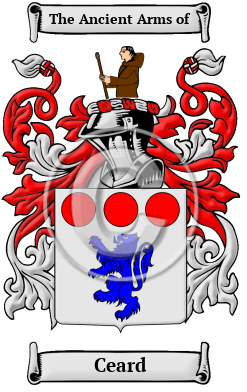
Show ContentsCeard History, Family Crest & Coats of Arms

Etymology of Ceard

What does the name Ceard mean?

The name Ceard comes from the ancient Scottish kingdom of Dalriada, where it was used to indicate someone who worked as a worker in brass. The name Ceard is an Anglicized form of the Gaelic "ceard", which refers to a craftsman, a traveling tinker who repaired pots and kettles, and a worker in brass. The family is believed to have made many of the Highland plaid brooches of brass.

Early Origins of the Ceard family

The surname Ceard was first found in Ayrshire (Gaelic: Siorrachd Inbhir Àir), formerly a county in the southwestern Strathclyde region of Scotland, that today makes up the Council Areas of South, East, and North Ayrshire, where they held a family seat from very ancient times, some say well before the Norman Conquest and the arrival of Duke William at Hastings in 1066 A.D.

Early History of the Ceard family

This web page shows only a small excerpt of our Ceard research. Another 196 words (14 lines of text) covering the years 1275 and 1600 are included under the topic Early Ceard History in all our PDF Extended History products and printed products wherever possible.

Ceard Spelling Variations

Since medieval scribes still spelled according to sound, records from that era contain an enormous number of spelling variations. In various documents Ceard has been spelled Caird, Kaird, Kerd, Keard, Ceard, Kerde, McIncaird, McKincaird, Kincaird and many more.

Early Notables of the Ceard family

More information is included under the topic Early Ceard Notables in all our PDF Extended History products and printed products wherever possible.

Migration of the Ceard family to Ireland

Some of the Ceard family moved to Ireland, but this topic is not covered in this excerpt. More information about their life in Ireland is included in all our PDF Extended History products and printed products wherever possible.

Migration of the Ceard family

Descendents of Dalriadan-Scottish families still populate many communities across North America. They are particularly common in Canada, since many went north as United Empire Loyalists at the time of the American War of Independence. Much later, in the late 19th and early 20th centuries, the highland games and Clan societies that now dot North America sprang up, allowing many Scots to recover their lost national heritage. Some of the first immigrants to cross the Atlantic and come to North America bore the name Ceard, or a variant listed above: William Caird settled in New Hampshire in 1718; Thomas Caird settled in Boston Massachusetts in 1765.


Houseofnames.com on Facebook
