| ![Show Contents]() Caws History, Family Crest & Coats of Arms Caws History, Family Crest & Coats of Arms
Etymology of CawsWhat does the name Caws mean? The Caws surname is derived from the Gaelic MacAoidh; "Aoidh" is Gaelic for fire, as well as the name of a pagan god. Early Origins of the Caws familyThe surname Caws was first found in Sutherland (Gaelic: Cataibh), a former county in northern Scotland, now part of the Council Area of Highland, where they held a family seat from very ancient times, some say well before the Norman Conquest and the arrival of Duke William at Hastings in 1066 A.D. Early History of the Caws familyThis web page shows only a small excerpt of our Caws research. Another 276 words (20 lines of text) covering the years 1329, 1408, 1411, 1429, 1506 and 1575 are included under the topic Early Caws History in all our PDF Extended History products and printed products wherever possible. Caws Spelling VariationsSpelling variations of this family name include: MacKay, MacCay, MacQuey, MacQuoid, MacKaw, MacKy, MacKye, MacCoy, McCoy and many more. Early Notables of the Caws familyMore information is included under the topic Early Caws Notables in all our PDF Extended History products and printed products wherever possible. Migration of the Caws family to IrelandSome of the Caws family moved to Ireland, but this topic is not covered in this excerpt.
Another 63 words (4 lines of text) about their life in Ireland is included in all our PDF Extended History products and printed products wherever possible.
| Caws migration to the United States | + |
Caws Settlers in United States in the 18th Century- Christian Caws, who arrived in Pennsylvania in 1786 1
- Dorothy Caws, who landed in Pennsylvania in 1786 1
- J Ct Caws, who arrived in Pennsylvania in 1786 1
- J Friderik Caws, who landed in Pennsylvania in 1786 1
| Historic Events for the Caws family | + |
- William Albert Caws, British Warrant Office Shipwright aboard the HMS Cornwall (1942) when she was struck by air bombers and sunk; he survived the sinking 2
The motto was originally a war cry or slogan. Mottoes first began to be shown with arms in the 14th and 15th centuries, but were not in general use until the 17th century. Thus the oldest coats of arms generally do not include a motto. Mottoes seldom form part of the grant of arms: Under most heraldic authorities, a motto is an optional component of the coat of arms, and can be added to or changed at will; many families have chosen not to display a motto.
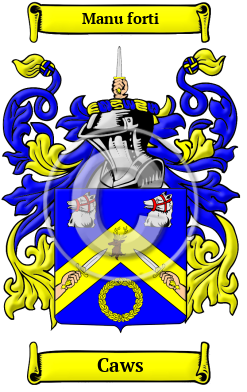
Motto: Manu forti
Motto Translation: With a strong hand.
- Filby, P. William, Meyer, Mary K., Passenger and immigration lists index : a guide to published arrival records of about 500,000 passengers who came to the United States and Canada in the seventeenth, eighteenth, and nineteenth centuries. 1982-1985 Cumulated Supplements in Four Volumes Detroit, Mich. : Gale Research Co., 1985, Print (ISBN 0-8103-1795-8)
- Force Z Survivors Crew List HMS Cornwall (Retrieved 2018, February 13th) - Retrieved from https://www.forcez-survivors.org.uk/biographies/listcornwallcrew.html#A
 |