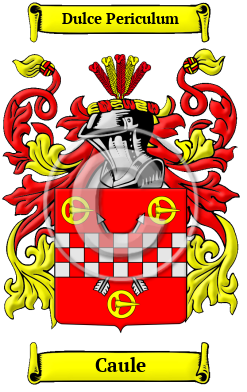
![Show Contents]() Caule History, Family Crest & Coats of Arms Caule History, Family Crest & Coats of Arms
Etymology of CauleWhat does the name Caule mean? The clans of the Scottish/English Borderlands spawned many enduring Scottish names. Caule comes from this Boernician region and is derived from the son of Amalghaidh, (an old Irish personal name). The distinguished name Caule is derived from the Gaelic name MacAmhalghaidh and was generally found in Dumbartonshire. Alternatively, the name could have come from the Gaelic name MacAmhlaibh or MacAmhaidh, which means son of Amlaib and in this case, the name was originally derived from the Norse King Olafr. This latter branch was generally found in the Hebrides. Early Origins of the Caule familyThe surname Caule was first found in at Ardencaple, in Dumbartonshire. Ardencaple "cape of the horses," was the ancestral home of the Lairds of Ardencaple and is located on the shores of the Gare Loch, in the historical district of Lennox, county Dumbarton. They were one of the Clans of MacAlpine. The history of the MacAulay Clan is particularly complex as there are two distinct branches, in addition to an infusion of MacAulays during the reign of Robert the Bruce. The name of Aulay, brother of the Earl of Lennox, is found on the Ragman Rolls, which confirms his pledge of allegiance to King Edward I of England. This branch entered into a bond of manrent with MacGregor of Glenstrae in 1591. The second branch of this Clan is that of the MacAulays of the Isle of Lewis. These Clansmen claimed descent from Aula (Olaf the Black), who was a thirteenth-century king of the Isles. Their lands were traditional centered around Uig. This branch was probably related to the numerous MacAulays of Ross and Sutherland. Finally, some members of a branch of the MacAulay Clann from Ireland were invited by Robert the Bruce to Scotland to help in his wars against the English. These last MacAulays may be ancient relatives to those of Ardincaple, Dumbartonshire. It was some while later that the MacAulays were first recognized as a Clan. Early History of the Caule familyThis web page shows only a small excerpt of our Caule research. Another 54 words (4 lines of text) covering the years 1595, 1767 and 1890 are included under the topic Early Caule History in all our PDF Extended History products and printed products wherever possible. Caule Spelling VariationsSpelling rules only evolved in the last few centuries with the invention of the printing press and the first dictionaries. Spelling variations are extremely common in names from before that period. Caule has been spelled MacAuly, MacAwley, MacAuley, MacAullay, MacAulley, MacAwlay, MacCaulay, MacCawley, MacGawley, Magawley, Cauley, Caulay, McCamley and many more. Early Notables of the Caule familythe 'MacCawlis' who appear on the roll of Broken Clans in 1595. Their fortunes fell, the last of their lands of Ardencaple were sold to the Duke of Argyll...
Another 29 words (2 lines of text) are included under the topic Early Caule Notables in all our PDF Extended History products and printed products wherever possible. Migration of the Caule family to IrelandSome of the Caule family moved to Ireland, but this topic is not covered in this excerpt.
Another 59 words (4 lines of text) about their life in Ireland is included in all our PDF Extended History products and printed products wherever possible. Migration of the Caule familyAfter making their great crossing, many Boernician-Scottish families settled along the east coast of North America. When the War of Independence broke out, United Empire Loyalists moved north to Canada while the rest stayed to fight. The ancestors of many of these Scots still populate the continent. This century, through Clan societies and other Scottish organizations, they began to rediscover their collective national heritage. Analysis of immigration records indicates that some of the first North American immigrants bore the name Caule or a variant listed above: Andrew MacAuly who landed in Potomac Maryland in 1730; James MacCauley who landed in Charles Town in 1772 with his wife; Kenneth MacAulay who landed in Philadelphia in 1774.
The motto was originally a war cry or slogan. Mottoes first began to be shown with arms in the 14th and 15th centuries, but were not in general use until the 17th century. Thus the oldest coats of arms generally do not include a motto. Mottoes seldom form part of the grant of arms: Under most heraldic authorities, a motto is an optional component of the coat of arms, and can be added to or changed at will; many families have chosen not to display a motto.
Motto: Dulce Periculum
Motto Translation: Danger is sweet
 |