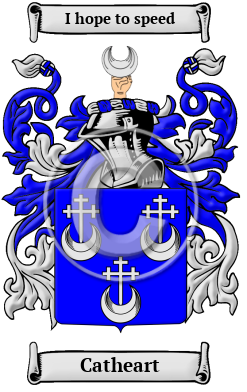
| ![Show Contents]() Catheart History, Family Crest & Coats of Arms Catheart History, Family Crest & Coats of Arms
Etymology of CatheartWhat does the name Catheart mean? Catheart was first used as a surname in the Scottish/English Borderlands by the Strathclyde-Briton. The first Catheart family lived in the region of Cathcart near Glasgow, along the "Cart" river. 1 Early Origins of the Catheart familyThe surname Catheart was first found in Renfrewshire (Gaelic: Siorrachd Rinn Friù), a historic county of Scotland, today encompassing the Council Areas of Renfrew, East Renfrewshire, and Iverclyde, in the Strathclyde region of southwestern Scotland. "The first of the family came to Scotland with Walter fitz Alan, the first of the Stewards, and from his name, Rainald, may like his leader, have been of Breton origin. Rainald appears as witness to a charter by Alan fitz Waiter conveying the patronage of the church of Ketheart to the monastery of Paisley c. 1178. He also witnessed, as Ranulfus de Ketkert, a similar charter by Alan, the son of Walter in favor of the same house c. 1202-1203. As Reginaldus de Cathekert, he witnessed another charter by the same Alan to Robert Croc of the lands of Kellebrid c. 1200. His son, William de Cathkert witnessed a charter whereby Duugallus filius Cristini de Levenax exchanged the lands of Cnoc with the monastery of Paisley for lands near Walkeinschaw in 1234. William de Kathkerte of the county of Arne rendered homage [to King Edward I of England] in 1296. Sir Alan of Cathcart, an adherent of Bruce, was probably the first to be designated dominus ejusdem in 1336." 2 Early History of the Catheart familyThis web page shows only a small excerpt of our Catheart research. Another 251 words (18 lines of text) covering the years 1160, 1178, 1200, 1230, 1296, 1447, 1513, 1546, 1622, 1721, 1742, 1755, 1766, 1771, 1773, 1776, 1777, 1783, 1800, 1805, 1806, 1807, 1843, 1859 and 1890 are included under the topic Early Catheart History in all our PDF Extended History products and printed products wherever possible. Catheart Spelling VariationsMedieval Scottish names are rife with spelling variations. This is due to the fact that scribes in that era spelled according to the sound of words, rather than any set of rules. Catheart has been spelled Cathcart, Cathert, Kethkert, Kethkart and others. Early Notables of the Catheart familyCharles Cathcart, 9th Baron Cathcart (1721-1776), soldier and ambassador, born 21 March 1721, the son of Charles, 8th Baron, a military officer of considerable distinction. The son at an early age entered the 3rd regiment of foot guards. In 1742 he commanded the 20th regiment of foot under the Earl of Stair. He accompanied the Duke of Cumberland through his campaigns in Flanders, Scotland, and Holland, acting as one of the duke's aides-de-camp at Fontenoy, and receiving in that battle a dangerous wound in his head. 3 Sir William Schaw Cathcart, 10th Baron Cathcart in the peerage of Scotland, and first Viscount...
Another 249 words (18 lines of text) are included under the topic Early Catheart Notables in all our PDF Extended History products and printed products wherever possible. Migration of the Catheart family to IrelandSome of the Catheart family moved to Ireland, but this topic is not covered in this excerpt.
Another 57 words (4 lines of text) about their life in Ireland is included in all our PDF Extended History products and printed products wherever possible. Migration of the Catheart familyMany Scots were left with few options other than to leave their homeland for the colonies across the Atlantic. Some of these families fought to defend their newfound freedom in the American War of Independence. Others went north to Canada as United Empire Loyalists. The ancestors of all of these families have recently been able to rediscover their roots through Clan societies and other Scottish organizations. Among them: Robert Cathcart who settled in New England in 1730; Alexander, Gabriel, James, John, Paul, Robert, Thomas, William Cathcart all arrived in Philadelphia, Pennsylvania between 1800 and 1840..
The motto was originally a war cry or slogan. Mottoes first began to be shown with arms in the 14th and 15th centuries, but were not in general use until the 17th century. Thus the oldest coats of arms generally do not include a motto. Mottoes seldom form part of the grant of arms: Under most heraldic authorities, a motto is an optional component of the coat of arms, and can be added to or changed at will; many families have chosen not to display a motto.
Motto: I hope to speed
- Lewis, Samuel, A Topographical Dictionary of Scotland. Institute of Historical Research, 1848, Print.
- Black, George F., The Surnames of Scotland Their Origin, Meaning and History. New York: New York Public Library, 1946. Print. (ISBN 0-87104-172-3)
- Smith, George (ed), Dictionary of National Biography. London: Smith, Elder & Co., 1885-1900. Print
 |