| ![Show Contents]() Casim History, Family Crest & Coats of Arms Casim History, Family Crest & Coats of Arms
Etymology of CasimWhat does the name Casim mean? The ancestors of the Casim family arrived in England following the Norman Conquest of 1066. The name Casim came from de Cassagne, the name of the House of the Lords of Montagu, who were a family of distinction from the province of Bearne, France. 1 Early Origins of the Casim familyThe surname Casim was first found in Hampshire, where a Ralph Cattessone was on record in 1115. Other early records include Robert Casseson in 1327 in the Subsidy Rolls of Cambridgeshire, John Catessone, on record in the Feet of Fines of Suffolk in 1366, and William Casson in the Register of the Freemen of the City of York in 1601. 2 Early History of the Casim familyThis web page shows only a small excerpt of our Casim research. Another 62 words (4 lines of text) covering the years 1789, 1815, 1820, 1821, 1829 and 1841 are included under the topic Early Casim History in all our PDF Extended History products and printed products wherever possible. Casim Spelling VariationsMultitudes of spelling variations are a hallmark of Anglo Norman names. Most of these names evolved in the 11th and 12th century, in the time after the Normans introduced their own Norman French language into a country where Old and Middle English had no spelling rules and the languages of the court were French and Latin. To make matters worse, medieval scribes spelled words according to sound, so names frequently appeared differently in the various documents in which they were recorded. The name was spelled Cassan, Cassane, Casson and others. Early Notables of the Casim familyStephen Hyde Cassan (1789-1841), English ecclesiastical biographer, son of Stephen Cassan, barrister, by his wife Sarah, daughter of Charles Mears, born in 1789 at Calcutta, where his father was sheriff. He was educated at Magdalen Hall, Oxford, and took his B.A. degree on 14 Jan. 1815. He received deacon's orders on 26 March following, and was ordained priest the next year. While curate of Frome, Somerset, in 1820, he made a runaway match...
Another 72 words (5 lines of text) are included under the topic Early Casim Notables in all our PDF Extended History products and printed products wherever possible. Migration of the Casim family to IrelandSome of the Casim family moved to Ireland, but this topic is not covered in this excerpt. More information about their life in Ireland is included in all our PDF Extended History products and printed products wherever possible. Migration of the Casim familyBecause of this political and religious unrest within English society, many people decided to immigrate to the colonies. Families left for Ireland, North America, and Australia in enormous numbers, traveling at high cost in extremely inhospitable conditions. The New World in particular was a desirable destination, but the long voyage caused many to arrive sick and starving. Those who made it, though, were welcomed by opportunities far greater than they had known at home in England. Many of these families went on to make important contributions to the emerging nations of Canada and the United States. Analysis of immigration records indicates that some of the first North American immigrants bore the name Casim or a variant listed above: Anty and Monty Cassan, both bonded passengers, who arrived in Boston Massachusetts in 1849; Andrew Cassan who settled in Philadelphia, Pennsylvania in 1850.
The motto was originally a war cry or slogan. Mottoes first began to be shown with arms in the 14th and 15th centuries, but were not in general use until the 17th century. Thus the oldest coats of arms generally do not include a motto. Mottoes seldom form part of the grant of arms: Under most heraldic authorities, a motto is an optional component of the coat of arms, and can be added to or changed at will; many families have chosen not to display a motto.
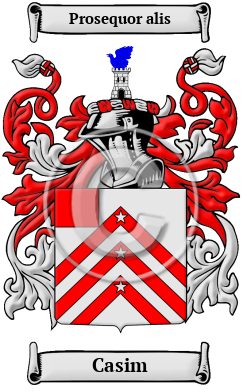
Motto: Prosequor alis
Motto Translation: I follow with speed.
- Lower, Mark Anthony, Patronymica Britannica, A Dictionary of Family Names of the United Kingdom. London: John Russel Smith, 1860. Print.
- Reaney, P.H and R.M. Wilson, A Dictionary of English Surnames. London: Routledge, 1991. Print. (ISBN 0-415-05737-X)
 |