
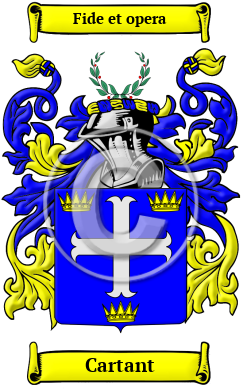
Show ContentsCartant History, Family Crest & Coats of Arms

Etymology of Cartant

What does the name Cartant mean?

The root of the ancient Dalriadan-Scottish name Cartant is the Celtic personal name Arthur. It denotes the 'son of arthur', which means noble one.

Early Origins of the Cartant family

The surname Cartant was first found in Argyllshire (Gaelic erra Ghaidheal), the region of western Scotland corresponding roughly with the ancient Kingdom of Dál Riata, in the Strathclyde region of Scotland, now part of the Council Area of Argyll and Bute, where they held a family seat from early times and their first records appeared on the census rolls taken by the ancient Kings of Scotland to determine the rate of taxation of their subjects.

Early History of the Cartant family

This web page shows only a small excerpt of our Cartant research. Another 184 words (13 lines of text) covering the years 1427, 1767, 1817 and 1890 are included under the topic Early Cartant History in all our PDF Extended History products and printed products wherever possible.

Cartant Spelling Variations

Historical recordings of the name Cartant include many spelling variations. They include They are the result of repeated translations of the name from Gaelic to English and inconsistencies in spelling rules. MacArthur, MacArtair, MacArter and many more.

Early Notables of the Cartant family

Alister MacArthur who was beheaded by James I in 1427; and John MacArthur of the Strachur branch (1767) who journeyed to Australia with the 102nd Regiment. He became actively involved in the development of the colony, introducing sheep, and improving the...
Another 41 words (3 lines of text) are included under the topic Early Cartant Notables in all our PDF Extended History products and printed products wherever possible.

Migration of the Cartant family to Ireland

Some of the Cartant family moved to Ireland, but this topic is not covered in this excerpt.
Another 60 words (4 lines of text) about their life in Ireland is included in all our PDF Extended History products and printed products wherever possible.

Migration of the Cartant family

Descendents of Dalriadan-Scottish families still populate many communities across North America. They are particularly common in Canada, since many went north as United Empire Loyalists at the time of the American War of Independence. Much later, in the late 19th and early 20th centuries, the highland games and Clan societies that now dot North America sprang up, allowing many Scots to recover their lost national heritage. Some of the first immigrants to cross the Atlantic and come to North America bore the name Cartant, or a variant listed above: Neil McArthur who settled in New York State in 1738 with his wife Mary Campbell and three children, Alexander, John, and Christian; Patrick McArthur also settled in New York State in 1738 with his wife Mary McDugall and children, Charles, Colin, and Jennet.


The Cartant Motto +

The motto was originally a war cry or slogan. Mottoes first began to be shown with arms in the 14th and 15th centuries, but were not in general use until the 17th century. Thus the oldest coats of arms generally do not include a motto. Mottoes seldom form part of the grant of arms: Under most heraldic authorities, a motto is an optional component of the coat of arms, and can be added to or changed at will; many families have chosen not to display a motto.

Motto: Fide et opera
Motto Translation: By fidelity and work.


Houseofnames.com on Facebook