| ![Show Contents]() Cahoun History, Family Crest & Coats of Arms Cahoun History, Family Crest & Coats of Arms
- Origins Available:
Scotland
Ireland
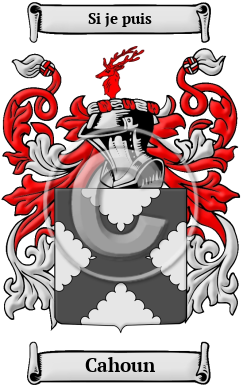
Etymology of CahounWhat does the name Cahoun mean? The ancestors of the name Cahoun come from the ancient Scottish tribe known as the Dalriadans. They lived along the rugged west coast of Scotland and on the Hebrides islands and used the name to indicate a person who lived in the former Aberdeenshire, derived from the Gaelic còil or cùil, which means "nook" or "corner." Colquhoun is properly pronounced "Ko-hoon." 1 Cahoun Coat of Arms CreationA stag's head appears in several Scottish crests. The Colquhouns of Luss got it for regaining the castle of Dumbarton by a stratagem. The story goes that the king asked the chief of Luss to recover it for him, and was answered, " If I can." After some planning he got up a mock chase by letting loose a stag on the level of the castle in the hope that it would attract the notice of the garrison, and that, on observing it, they would leave the tower to join in the chase, not suspecting artifice, and thus afford an opportunity of recovering the castle. The ruse was completely successful. The garrison dashed forward to take part in the sport. During the absence of the soldiers, Colquhoun of Luss, with his followers, took possession of the castle and restored it to the King, who, as a reward, granted the armorial bearings which have ever since been borne by the Colquhouns of Luss, viz., a deer's head, with the motto, ''Si je puis " (If I can.) 2 Early Origins of the Cahoun familyThe surname Cahoun was first found in Angus (Gaelic: Aonghas), part of the Tayside region of northeastern Scotland, and present day Council Area of Angus, formerly known as Forfar or Forfarshire where they held a seat at Luss and possessed vast manors and elegant estates. Although not formally recognized before the 11th century (the Clan system was not developed until the reign of King Malcolm Ceanmore and his second wife, Margaret) this Clan has a unified history that may well precede that time. It is believed that they occupied this area well before the Norman Conquest and the arrival of Duke William at Hastings in 1066 AD. According to Clan tradition, the Calhoun Clan is descended from an early Celtic priest named St. Kessog who lived in Glen Luss, the Monks' Isle in Loch Lomond. Early History of the Cahoun familyThis web page shows only a small excerpt of our Cahoun research. Another 255 words (18 lines of text) covering the years 1200, 1241, 1602, 1715 and 1890 are included under the topic Early Cahoun History in all our PDF Extended History products and printed products wherever possible. Cahoun Spelling VariationsMany spelling variations of Cahoun have been recorded over the years, including These are the result of the medieval practice of spelling according to sound and repeated translation between Gaelic and English. Colquhoun, Colhoun, Colhoon, Cahoun, Cohoun, Cahoon, Cohoon, Culquhoun, Cahune, Cohune, Cowquhone, Colquhone, Culquhown, Cahoone, Calhoun, Kalhoun, Kulhoun, Kolhoun, Calhoon, Calloon, Culloone, Collune and many more. Early Notables of the Cahoun familyMore information is included under the topic Early Cahoun Notables in all our PDF Extended History products and printed products wherever possible. Migration of the Cahoun family to IrelandSome of the Cahoun family moved to Ireland, but this topic is not covered in this excerpt.
Another 109 words (8 lines of text) about their life in Ireland is included in all our PDF Extended History products and printed products wherever possible. Migration of the Cahoun familySettlers from Scotland put down roots in communities all along the east coast of North America. Some moved north from the American colonies to Canada as United Empire Loyalists during the American War of Independence. As Clan societies and highland games started in North America in the 20th century many Scots rediscovered parts of their heritage. Early North American records indicate many people bearing the name Cahoun were among those contributors: Mary Cahoone who settled in New York in 1803; John Colquhoon settled in Boston Mass in 1651; Archibald Colquhoon and his wife Anne settled in Wilmington N.C. in 1775.
The motto was originally a war cry or slogan. Mottoes first began to be shown with arms in the 14th and 15th centuries, but were not in general use until the 17th century. Thus the oldest coats of arms generally do not include a motto. Mottoes seldom form part of the grant of arms: Under most heraldic authorities, a motto is an optional component of the coat of arms, and can be added to or changed at will; many families have chosen not to display a motto.
Motto: Si je puis
Motto Translation: If I can
- Black, George F., The Surnames of Scotland Their Origin, Meaning and History. New York: New York Public Library, 1946. Print. (ISBN 0-87104-172-3)
- Polson, Alexander, The Romance of Scottish Crests and Mottoes. Inverness: Walter Alexander, Inglis Street 1929. Print
 |