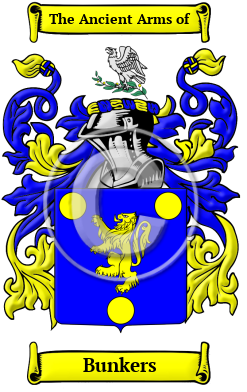
| ![Show Contents]() Bunkers History, Family Crest & Coats of Arms Bunkers History, Family Crest & Coats of Arms
- Origins Available:
England
Etymology of BunkersWhat does the name Bunkers mean? When the ancestors of the Bunkers family emigrated to England following the Norman Conquest in 1066 they brought their family name with them. They lived in Suffolk at Bungay, a market town that dates back to the Domesday Book where it was listed as Bunghea, probably derived from the Old English personal name + inga + eg and meant "island of the family or followers of a man called Buna." 1 Another reference claims the placename was derived from the term "le-bon-eye," signifying "the good island," as it was nearly surrounded by the river Waveney, which was once a broad stream. Soon after the Norman Conquest, a castle was built, which, from its situation and the strength of its fortifications, was deemed impregnable by its possessor, Hugh Bigot, Earl of Norfolk, in the reign of Stephen; but that monarch, in the 6th of his reign, in the year 1140, came with his army and took it. Over the years Bungay Castle has fallen into ruins, but in 1934 the amateur archaeologist Leonard Cane convinced people that a restoration was needed. Today it is owned by the Bungay Castle Trust. Early Origins of the Bunkers familyThe surname Bunkers was first found in Suffolk where they held a family seat as Lords of the Manor of Bungay at the time of the Norman Conquest of England by Duke William of Normandy in 1066 A.D. Conjecturally they are descended from William de Noyers who held the lands of Bungay from the King. At the time of the taking of the Domesday Book survey in 1086 the holdings consisted of 4 Churches, 2.5 mills, 60 goats and 100 sheep. Bungay Castle was built by the Norman Earl Hugh Bigod in the 12th century. Reginal de Bungheye was Lord Mayor of London in 1240. Thomas Bungay (fl. 1290), was a learned Franciscan friar, born at Bungay, Suffolk, and educated at Paris and Oxford. He became the tenth reader in divinity at Oxford. He later moved to Cambridge, where he held a similar position. 2 Early History of the Bunkers familyThis web page shows only a small excerpt of our Bunkers research. Another 40 words (3 lines of text) covering the year 1588 is included under the topic Early Bunkers History in all our PDF Extended History products and printed products wherever possible. Bunkers Spelling VariationsThe English language only became standardized in the last few centuries. For that reason, spelling variations are common among many Anglo-Norman names. The shape of the English language was frequently changed with the introduction of elements of Norman French, Latin, and other European languages; even the spelling of literate people's names were subsequently modified. Bunkers has been recorded under many different variations, including Bungey, Bungay, Bunker, Bunkar, Bunkey, Bunkay, Bungy and many more. Early Notables of the Bunkers familyMore information is included under the topic Early Bunkers Notables in all our PDF Extended History products and printed products wherever possible. Migration of the Bunkers familyTo escape the uncertainty of the political and religious uncertainty found in England, many English families boarded ships at great expense to sail for the colonies held by Britain. The passages were expensive, though, and the boats were unsafe, overcrowded, and ridden with disease. Those who were hardy and lucky enough to make the passage intact were rewarded with land, opportunity, and social environment less prone to religious and political persecution. Many of these families went on to be important contributors to the young nations of Canada and the United States where they settled. Bunkerss were some of the first of the immigrants to arrive in North America: James and George Bunker who settled in Boston Massachusetts in 1630; George Bunker settled in Charlestown, Massachusetts in 1630; G. and J. Bunker arrived in San Francisco Cal. in 1850.
- Mills, A.D., Dictionary of English Place-Names. Oxford: Oxford University Press, 1991. Print. (ISBN 0-19-869156-4)
- Smith, George (ed), Dictionary of National Biography. London: Smith, Elder & Co., 1885-1900. Print
 |