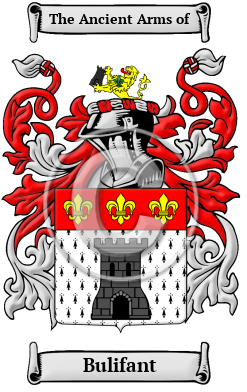
| ![Show Contents]() Bulifant History, Family Crest & Coats of Arms Bulifant History, Family Crest & Coats of Arms
- Origins Available:
England
Etymology of BulifantWhat does the name Bulifant mean? Bulifant is a name that first reached England following the Norman Conquest of 1066. The Bulifant family lived in Oxfordshire where they were established since the early Middle Ages. Early Origins of the Bulifant familyThe surname Bulifant was first found in Oxfordshire where they held a family seat as Lords of the Manor with they were granted a lordship.After the Battle of Hastings in 1066, William, Duke of Normandy, having prevailed over King Harold, granted most of Britain to his many victorious Barons. It was not uncommon to find a Baron, or a Bishop, with 60 or more Lordships scattered throughout the country. These he gave to his sons, nephews and other junior lines of his family and they became known as under-tenants. They adopted the Norman system of surnames which identified the under-tenant with his holdings so as to distinguish him from the senior stem of the family. After many rebellious wars between his Barons, Duke William, commissioned a census of all England to determine in 1086, settling once and for all, who held which land. He called the census the Domesday Book, 1 indicating that those holders registered would hold the land until the end of time. Hence, William Bonnifant (Bullivant) held estates in 1207 in that shire. Early History of the Bulifant familyThis web page shows only a small excerpt of our Bulifant research. Another 131 words (9 lines of text) covering the years 1273, 1279, 1472, 1524 and 1674 are included under the topic Early Bulifant History in all our PDF Extended History products and printed products wherever possible. Bulifant Spelling VariationsIt is only in the last few hundred years that the English language has been standardized. For that reason, Anglo-Norman surnames like Bulifant are characterized by many spelling variations. Scribes and monks in the Middle Ages spelled names they sounded, so it is common to find several variations that refer to a single person. As the English language changed and incorporated elements of other European languages such as Norman French and Latin, even literate people regularly changed the spelling of their names. The variations of the name Bulifant include Bullivant, Bullivant, Bonnifant, Bonifant, Bonafont, Bullifent, Bulifent, Bulifant, Bonifent, Bonnivant, Bonifant and many more. Early Notables of the Bulifant familyMore information is included under the topic Early Bulifant Notables in all our PDF Extended History products and printed products wherever possible. Migration of the Bulifant familyFaced with the chaos present in England at that time, many English families looked towards the open frontiers of the New World with its opportunities to escape oppression and starvation. People migrated to North America, as well as Australia and Ireland in droves, paying exorbitant rates for passages in cramped, unsafe ships. Many of the settlers did not make the long passage alive, but those who did see the shores of North America were welcomed with great opportunity. Many of the families that came from England went on to make essential contributions to the emerging nations of Canada and the United States. Some of the first immigrants to cross the Atlantic and come to North America carried the name Bulifant, or a variant listed above: Rebecca Bullifant settled in Virginia in 1653; Benjamin Bullivant settled in Boston in 1688 and Francis Bullivant settled in Virginia in 1699.
- Williams, Dr Ann. And G.H. Martin, Eds., Domesday Book A Complete Translation. London: Penguin, 1992. Print. (ISBN 0-141-00523-8)
 |