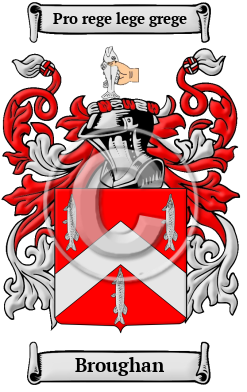
| ![Show Contents]() Broughan History, Family Crest & Coats of Arms Broughan History, Family Crest & Coats of Arms
Etymology of BroughanWhat does the name Broughan mean? An ancient Strathclyde-Briton family from the Scottish/English Borderlands were the first to use the name Broughan. They lived in Galloway in the southwest of Scotland. The Rhiged lived in what later became the northern English counties of Cumberland, Westmorland, and Lancashire. Early Origins of the Broughan familyThe surname Broughan was first found in Westmorland, at Brougham Castle a medieval building about 2 miles (3.2 km) south-east of Penrith in what is now known as Cumbria. “The De Burghams held it temp. Edward the Confessor.” 1 This castle was built on an ancient Roman fort named Brocavum and was originally at the intersection of three Roman roads. Early History of the Broughan familyThis web page shows only a small excerpt of our Broughan research. Another 83 words (6 lines of text) covering the years 1050, 1665, 1698, 1778, 1780, 1833 and 1868 are included under the topic Early Broughan History in all our PDF Extended History products and printed products wherever possible. Broughan Spelling VariationsBefore the printing press standardized spelling in the last few hundred years, no general rules existed in the English language. Spelling variations in Scottish names from the Middle Ages are common even within a single document. Broughan has been spelled Brougham, Bruham, Browham and others. Early Notables of the Broughan familyHenry Brougham (1665-1698), an English divine from Scales Hall, Cumberland. He was one of the twelve children of Henry Brougham of Scales Hall, Cumberland, sheriff for the county in the 6th of William III. 2 Henry Peter Brougham, 1st Baron Brougham and Vaux (1778-1868), was a...
Another 44 words (3 lines of text) are included under the topic Early Broughan Notables in all our PDF Extended History products and printed products wherever possible. Migration of the Broughan family to IrelandSome of the Broughan family moved to Ireland, but this topic is not covered in this excerpt.
Another 32 words (2 lines of text) about their life in Ireland is included in all our PDF Extended History products and printed products wherever possible. Migration of the Broughan familyFor Scottish immigrants, the great expense of travel to North America did not seem such a problem in those unstable times. Acres of land awaited them and many got the chance to fight for their freedom in the American War of Independence. These Scots and their ancestors went on to play important roles in the forging of the great nations of the United States and Canada. Among them: George Brougham who settled in Maryland in 1774; Mrs. Brougham arrived in San Francisco California in 1852.
| Contemporary Notables of the name Broughan (post 1700) | + |
- Paul Broughan, American artist, known for Little Bear (2015), Void (2018) and Havana (2022)
- Jude Broughan (b. 1976), New Zealand artist and educator, born in Hamilton, New Zealand and now based in Brooklyn, New York
- John Broughan, Irish researcher at the University College Dublin, Ireland
- Christine Broughan, British academic, Deputy Faculty Pro Vice Chancellor, Northumbria University
- Peter Broughan (b. 1995), British producer and writer, known for Rob Roy, The Young Person's Guide to Becoming a Rock Star (1998) and Paradise
- Thomas "Tommy" Broughan (b. 1947), Irish Independent politician who served as a Teachta Dála (TD) from 1992 to 2020
- Thomas P. "Tommy" Broughan (b. 1947), Irish Independents 4 Change politician, Member of Teachta Dála for Dublin North-East since 1992
The motto was originally a war cry or slogan. Mottoes first began to be shown with arms in the 14th and 15th centuries, but were not in general use until the 17th century. Thus the oldest coats of arms generally do not include a motto. Mottoes seldom form part of the grant of arms: Under most heraldic authorities, a motto is an optional component of the coat of arms, and can be added to or changed at will; many families have chosen not to display a motto.
Motto: Pro rege lege grege
Motto Translation: For King, the law, and the people.
- Lower, Mark Anthony, Patronymica Britannica, A Dictionary of Family Names of the United Kingdom. London: John Russel Smith, 1860. Print.
- Smith, George (ed), Dictionary of National Biography. London: Smith, Elder & Co., 1885-1900. Print
 |