
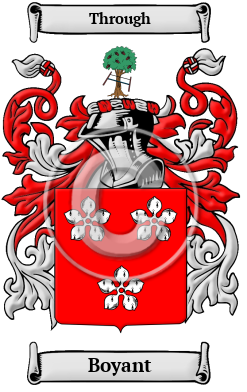
Show ContentsBoyant History, Family Crest & Coats of Arms

Etymology of Boyant

What does the name Boyant mean?

Boyant is a name whose ancestors lived among the Picts, a tribe in ancient Scotland. The Boyant family lived in the lands of Boyne, near Portsoy in Banffshire since very early times. Translating from the Gaelic, the name means dweller by the river Boyne.

Early Origins of the Boyant family

The surname Boyant was first found in Banffshire (Gaelic: Siorrachd Bhanbh), former Scottish county located in the northeasterly Grampian region of Scotland, now of divided between the Council Areas of Moray and Aberdeenshire, where they held a family seat in the ancient thanedom of Boyne near Portsoy in that shire.

Early History of the Boyant family

This web page shows only a small excerpt of our Boyant research. Another 128 words (9 lines of text) covering the years 1556, 1577, 1591, 1613, 1690, 1750 and 1810 are included under the topic Early Boyant History in all our PDF Extended History products and printed products wherever possible.

Boyant Spelling Variations

The appearance of the printing press and the first dictionaries in the last few hundred years did much to standardize spelling. Prior to that time scribes spelled according to sound, a practice that resulted in many spelling variations. Boyant has been spelled Boyne, Boyn, Boynd and others.

Early Notables of the Boyant family

More information is included under the topic Early Boyant Notables in all our PDF Extended History products and printed products wherever possible.

Migration of the Boyant family to Ireland

Some of the Boyant family moved to Ireland, but this topic is not covered in this excerpt.
Another 32 words (2 lines of text) about their life in Ireland is included in all our PDF Extended History products and printed products wherever possible.

Migration of the Boyant family

The expense of the crossing to the North American colonies seemed small beside the difficulties of remaining in Scotland. It was a long and hard trip, but at its end lay the reward of freedom. Some Scots remained faithful to England and called themselves United Empire Loyalists, while others fought in the American War of Independence. Much of this lost Scottish heritage has been recovered in the last century through Clan societies and other patriotic Scottish organizations. A search of immigration and passenger lists revealed many important, early immigrants to North America bearing the name of Boyant: Patrick Boyne who arrived in Philadelphia in 1874; Mathew Boyn arrived in Philadelphia in 1804 from Ireland.


The Boyant Motto +

The motto was originally a war cry or slogan. Mottoes first began to be shown with arms in the 14th and 15th centuries, but were not in general use until the 17th century. Thus the oldest coats of arms generally do not include a motto. Mottoes seldom form part of the grant of arms: Under most heraldic authorities, a motto is an optional component of the coat of arms, and can be added to or changed at will; many families have chosen not to display a motto.

Motto: Through


Houseofnames.com on Facebook
