| ![Show Contents]() Bornes History, Family Crest & Coats of Arms Bornes History, Family Crest & Coats of Arms
Etymology of BornesWhat does the name Bornes mean? The Bornes name has descended through the generations from the ancient Anglo-Saxon culture. Their name comes from having lived at or near a local stream or a spring. Bourn is a small village and civil parish in South Cambridgeshire. The population of the parish was 1,764 people at the time of the 2001 census. Bourn Castle was located there and originally consisted of wooden buildings on an earthwork enclosure which was erected during the reign of William the Conqueror. This was burnt down during the reign of Henry III. In the early 16th century Bourn Hall was built on part of the site. Early Origins of the Bornes familyThe surname Bornes was first found in Lincolnshire at Bourne, a market town and civil parish in the South Kesteven district which dates back to the Domesday Book where it was listed as Brune. The place name was derived from the Old English word burna or perhaps the Old Scandinavian word brunnr. The aforementioned Bourn in South Cambridgeshire also dates back to the Domesday Book where it was listed at that time as Brune. It has a similar origin. 1 Bourne Abbey is in Bourne, Lincolnshire dates back to before Domesday Book in 1086. At that time, it was listed as "half a church" and had a priest. In other words, it was a small church but standards of those days. Bourne Abbey and the surrounding area was held by Ogier the Breton and was a major fishery holding at the time 2,500 eels. 2 Early History of the Bornes familyThis web page shows only a small excerpt of our Bornes research. Another 63 words (4 lines of text) covering the years 1524, 1531, 1560, 1569, 1583, 1590, 1611, 1648, 1679, 1689, 1690, 1696, 1714, 1719, 1733, 1754 and 1796 are included under the topic Early Bornes History in all our PDF Extended History products and printed products wherever possible. Bornes Spelling VariationsOnly recently has spelling become standardized in the English language. As the English language evolved in the Middle Ages, the spelling of names changed also. The name Bornes has undergone many spelling variations, including Bourne, Borne, Bourn and others. Early Notables of the Bornes familyWilliam Bourne or Bourn; (d. 1583), English mathematician, son of William Bourne of Gravesend, who died 1560; Immanuel Bourne (1590-1679), English divine from East Haddon, Northamptonshire; and Nehemiah Bourne (c. 1611-1690), an English Royal Navy Admiral who emigrated to America after the Restoration, retiring his appointment.
Samuel Bourn, the Elder (1648-1719), was an English dissenting minister, born in 1648 at Derby, where his father and grandfather, who were clothiers, had shown some public spirit in providing the town with a water supply. His son, Samuel Bourn, the...
Another 86 words (6 lines of text) are included under the topic Early Bornes Notables in all our PDF Extended History products and printed products wherever possible. Migration of the Bornes family to IrelandSome of the Bornes family moved to Ireland, but this topic is not covered in this excerpt.
Another 43 words (3 lines of text) about their life in Ireland is included in all our PDF Extended History products and printed products wherever possible. Migration of the Bornes familyTo escape the unstable social climate in England of this time, many families boarded ships for the New World with the hope of finding land, opportunity, and greater religious and political freedom. Although the voyages were expensive, crowded, and difficult, those families that arrived often found greater opportunities and freedoms than they could have experienced at home. Many of those families went on to make significant contributions to the rapidly developing colonies in which they settled. Early North American records indicate many people bearing the name Bornes were among those contributors: Mary Bourn who arrived in Philadelphia in 1774; John Bourn settled in Barbados with his wife and sons in 1680; Benjamin Bourne settled in Virginia in 1650.
The motto was originally a war cry or slogan. Mottoes first began to be shown with arms in the 14th and 15th centuries, but were not in general use until the 17th century. Thus the oldest coats of arms generally do not include a motto. Mottoes seldom form part of the grant of arms: Under most heraldic authorities, a motto is an optional component of the coat of arms, and can be added to or changed at will; many families have chosen not to display a motto.
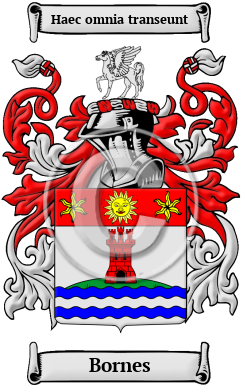
Motto: Haec omnia transeunt
Motto Translation: All these things pass away.
- Mills, A.D., Dictionary of English Place-Names. Oxford: Oxford University Press, 1991. Print. (ISBN 0-19-869156-4)
- Williams, Dr Ann. And G.H. Martin, Eds., Domesday Book A Complete Translation. London: Penguin, 1992. Print. (ISBN 0-141-00523-8)
 |