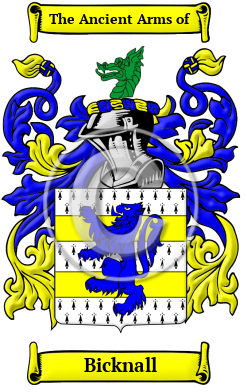
| ![Show Contents]() Bicknall History, Family Crest & Coats of Arms Bicknall History, Family Crest & Coats of Arms
Etymology of BicknallWhat does the name Bicknall mean? Bicknall is a name of ancient Anglo-Saxon origin and comes from the family once having lived in one of two places. Some bearers of the surname Bicknall derive their name from the parish of Bickenhill, which lies seven miles from Birmingham in the county of Warwickshire. 1 Bickenhill Church is a parish, in the union of Meriden, Solihull division of the hundred of Hemlingford, N. division of Warwickshire. "This place is of considerable antiquity, and included Kington, or Kingsford, now partly in this parish and partly in that of Solihull." 2 Other members of the family come from the parish of Bickenhall, otherwise known as Bicknell, which is near Taunton in the county of Somerset. 2 Early Origins of the Bicknall familyThe surname Bicknall was first found in Somerset and Warwickshire, where Thomas de Bikenhulle was the first on record in the Curia Regis Rolls of 1214. Later, John de Bikenhull and Walter Bykenhulle were listed in the Subsidy Rolls for Somerset in 1327. 3 Early History of the Bicknall familyThis web page shows only a small excerpt of our Bicknall research. Another 100 words (7 lines of text) covering the years 1310, 1318, 1349, 1611, 1629, 1645, 1660, 1695, 1723, 1788, 1796, 1861 and 1948 are included under the topic Early Bicknall History in all our PDF Extended History products and printed products wherever possible. Bicknall Spelling VariationsSound was what guided spelling in the essentially pre-literate Middle Ages, so one person's name was often recorded under several variations during a single lifetime. Also, before the advent of the printing press and the first dictionaries, the English language was not standardized. Therefore, spelling variations were common, even among the names of the most literate people. Known variations of the Bicknall family name include Bicknell, Bicknall, Bickenell, Bickenall, Bickenhall, Bickwell, Bignell, Bignall, Bignold, Bicknoll, Bignal, Bignel, Bignoll and many more. Early Notables of the Bicknall familyHenry Bignell (1611-1660?), English divine, born in the parish of St. Mary, Oxford, in July 161, son of Foulk Bignell of Souldern, Oxfordshire. In 1629 he became a servitor of Brasenose College, and subsequently entered at St. Mary's Hall. After taking the degree of B.A. he was ordained and set up as a schoolmaster. In 1645 he was made rector of St. Peter-le-Bayly, Oxford, but was ejected from his benefice for scandalous conduct. Shortly before the Restoration he went out to...
Another 80 words (6 lines of text) are included under the topic Early Bicknall Notables in all our PDF Extended History products and printed products wherever possible. Migration of the Bicknall family to IrelandSome of the Bicknall family moved to Ireland, but this topic is not covered in this excerpt.
Another 67 words (5 lines of text) about their life in Ireland is included in all our PDF Extended History products and printed products wherever possible.
| Bicknall migration to the United States | + |
For political, religious, and economic reasons, thousands of English families boarded ships for Ireland, Canada, the America colonies, and many of smaller tropical colonies in the hope of finding better lives abroad. Although the passage on the cramped, dank ships caused many to arrive in the New World diseased and starving, those families that survived the trip often went on to make valuable contributions to those new societies to which they arrived. Early immigrants bearing the Bicknall surname or a spelling variation of the name include:
Bicknall Settlers in United States in the 18th Century- Edward Bicknall, who settled in Maryland in 1774
| Bicknall migration to West Indies | + |
The British first settled the British West Indies around 1604. They made many attempts but failed in some to establish settlements on the Islands including Saint Lucia and Grenada. By 1627 they had managed to establish settlements on St. Kitts (St. Christopher) and Barbados, but by 1641 the Spanish had moved in and destroyed some of these including those at Providence Island. The British continued to expand the settlements including setting the First Federation in the British West Indies by 1674; some of the islands include Barbados, Bermuda, Cayman Island, Turks and Caicos, Jamaica and Belize then known as British Honduras. By the 1960's many of the islands became independent after the West Indies Federation which existed from 1958 to 1962 failed due to internal political conflicts. After this a number of Eastern Caribbean islands formed a free association. 4Bicknall Settlers in West Indies in the 17th Century- William Bicknall, who settled in Barbados with his servants in 1680
- Barber, Henry, British Family Names London: Elliot Stock, 62 Paternoster Row, 1894. Print.
- Lewis, Samuel, A Topographical Dictionary of England. Institute of Historical Research, 1848, Print.
- Reaney, P.H and R.M. Wilson, A Dictionary of English Surnames. London: Routledge, 1991. Print. (ISBN 0-415-05737-X)
- https://en.wikipedia.org/wiki/British_West_Indies
 |