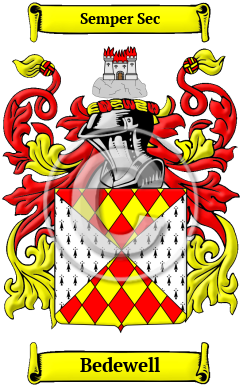
| ![Show Contents]() Bedewell History, Family Crest & Coats of Arms Bedewell History, Family Crest & Coats of Arms
Etymology of BedewellWhat does the name Bedewell mean? The name Bedewell is of Anglo-Saxon origin and came from when a family lived in Bidwell, Hertfordshire. This place name derives from the Old English words "byde," meaning "tub," and "well," meaning a "spring," or "stream." Combined the name means "dweller by the spring or stream in a shallow valley." 1 Early Origins of the Bedewell familyThe surname Bedewell was first found in Bedfordshire (Old English: Bedanfordscir), located in Southeast-central England, formerly part of the Anglo-Saxon kingdom of Mercia, where Bidwell was said to be a picturesque hamlet lying to the north-west of Houghton village. 2 3 There is an early record of a Stephen de Bedewellin in Essex in the Calendar of the Close Rolls, in 1229. 1 Early records of the name mention Bidewell (without surname) documented in County Surrey in the Pipe Rolls of 1185. Stephen de Bedewell was recorded in the year 1229 in County Essex. Bedewell (without surname) appears in 1240 in County Essex and Bidewelle (without surname) was documented in 1330 in County Yorkshire. 1 William Bedewell of Yorkshire was listed in the Yorkshire Poll Tax of 1379. 4 Early History of the Bedewell familyThis web page shows only a small excerpt of our Bedewell research. Another 113 words (8 lines of text) covering the years 1323, 1388, 1420, 1508, 1520, 1532, 1537, 1561, 1562, 1571, 1589, 1595, 1627, 1632, 1641, 1642, 1646, 1650, 1654 and 1656 are included under the topic Early Bedewell History in all our PDF Extended History products and printed products wherever possible. Bedewell Spelling VariationsSound was what guided spelling in the essentially pre-literate Middle Ages, so one person's name was often recorded under several variations during a single lifetime. Also, before the advent of the printing press and the first dictionaries, the English language was not standardized. Therefore, spelling variations were common, even among the names of the most literate people. Known variations of the Bedewell family name include Bedwell, Bedwel, Bedewell, Bidwell, Bidewell and many more. Early Notables of the Bedewell familyWilliam Bedwell (1561-1632), Vicar of Tottenham, Middlesex, an English priest and scholar, who specialized in mathematics and foreign languages and Thomas Bedwell, who held the position of "Storekeeper of the Ordnance" of England, 1589-1595.
William Bedwell (d. 1632), was nephew of "Thomas Bedwell, and father of Arabic studies in England, was born in 1561 or 1562, for his tombstone in the chancel of Tottenham church makes him aged 70 at his death on 5 May 1632...
Another 74 words (5 lines of text) are included under the topic Early Bedewell Notables in all our PDF Extended History products and printed products wherever possible. Migration of the Bedewell family to IrelandSome of the Bedewell family moved to Ireland, but this topic is not covered in this excerpt.
Another 162 words (12 lines of text) about their life in Ireland is included in all our PDF Extended History products and printed products wherever possible. Migration of the Bedewell familyFor political, religious, and economic reasons, thousands of English families boarded ships for Ireland, the Canadas, the America colonies, and many of smaller tropical colonies in the hope of finding better lives abroad. Although the passage on the cramped, dank ships caused many to arrive in the New World diseased and starving, those families that survived the trip often went on to make valuable contributions to those new societies to which they arrived. Early immigrants bearing the Bedewell surname or a spelling variation of the name include : John Bedwell, who came to Somers Islands in 1662; Elizabeth Bedwell, who arrived in Virginia in 1664; Hugh Bidwell, who arrived in South Carolina sometime between 1670 and 1679.
The motto was originally a war cry or slogan. Mottoes first began to be shown with arms in the 14th and 15th centuries, but were not in general use until the 17th century. Thus the oldest coats of arms generally do not include a motto. Mottoes seldom form part of the grant of arms: Under most heraldic authorities, a motto is an optional component of the coat of arms, and can be added to or changed at will; many families have chosen not to display a motto.
Motto: Semper Sec
Motto Translation: Always Thus
- Reaney, P.H and R.M. Wilson, A Dictionary of English Surnames. London: Routledge, 1991. Print. (ISBN 0-415-05737-X)
- Smith, Eldson Coles, New Dictionary of American Family Names New York: Harper & Row, 1956. Print
- Barber, Henry, British Family Names London: Elliot Stock, 62 Paternoster Row, 1894. Print.
- Bardsley, C.W, A Dictionary of English and Welsh Surnames: With Special American Instances. Wiltshire: Heraldry Today, 1901. Print. (ISBN 0-900455-44-6)
 |