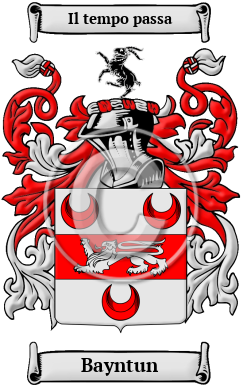
| ![Show Contents]() Bayntun History, Family Crest & Coats of Arms Bayntun History, Family Crest & Coats of Arms
Early Origins and Etymology of BayntunThe surname Bayntun was first found in Northumberland, where Osgode on Badingtune was listed there in 972. 1 Bainton (St. Mary), is a parish, in the union of Stamford, soke of Peterborough in Northumberland. Bainton is also found in Oxfordshire, Cambridgeshire and Yorkshire 2 as the place name literally means "estate associated with a man called Bada," from the Old English personal name + "-ing" + "tun." 3 Cambridgeshire has the oldest listing of the place name c. 980 when it was spelt Badingtun. The Assize Rolls for Yorkshire includes an entry for Turstan de Baynton in 1219, while the Feet of Fines for Warwickshire lists William de Baynton as holding lands there in 1361. 1 In Scotland, Banton is a small parish, forming part of the parish of Kilsyth, in the county of Stirling, inhabited principally by colliers and miners. 4 Early History of the Bayntun familyThis web page shows only a small excerpt of our Bayntun research. Another 162 words (12 lines of text) covering the years 1200, 1471, 1480, 1540, 1544, 1593, 1597, 1614, 1618, 1621, 1640, 1653, 1657, 1661, 1664, 1672, 1679, 1685, 1690, 1691 and 1734 are included under the topic Early Bayntun History in all our PDF Extended History products and printed products wherever possible. Bayntun Spelling VariationsDuring the era when a person's name, tribe and posterity was one of his most important possessions, many different spellings were found in the archives examined. Bayntun occurred in many references, and spelling variations of the name found included Baynton, Bayntun, Bainton, Bainten, Banting, Baynten and many more. Early Notables of the Bayntun family- Sir Henry Bayntun of Bromham, Wiltshire; Sir Edward Bayntun (1480-1544), from Bromham, Wiltshire; he was a gentleman at the court of Henry VIII of England, vice-chamberlain to Anne Boleyn, and brother...
Migration of the Bayntun familyGradually becoming disenchanted with life in Ireland many of these uprooted families sailed aboard the armada of sailing ships known as the "White Sails" which plied the stormy Atlantic. These overcrowded ships often arrived with only 60 to 70% of their original passenger list, many dying of illness and the elements, were buried at sea. In North America, early immigrants bearing the family name Bayntun, or a spelling variation of the surname include: Hester Baynton who settled in Virginia in 1725; William Baynton who settled in Philadelphia, Pennsylvania in 1720; Henry Bayntin settled in Newbern in 1820..
| Contemporary Notables of the name Bayntun (post 1700) | + |
- Sir Henry William Bayntun GCB (1766-1840), English senior officer in the Royal Navy who served in French Revolutionary and Napoleonic Wars, captain of HMS Leviathan at the Battle of Trafalgar
- Amelia Bayntun (1919-1988), English actress, best known for her starring role in a number of Carry On films
- Samuel Adlam Bayntun (1804-1833), British soldier and Member of House of Commons 1830-1833
The motto was originally a war cry or slogan. Mottoes first began to be shown with arms in the 14th and 15th centuries, but were not in general use until the 17th century. Thus the oldest coats of arms generally do not include a motto. Mottoes seldom form part of the grant of arms: Under most heraldic authorities, a motto is an optional component of the coat of arms, and can be added to or changed at will; many families have chosen not to display a motto.
Motto: Il tempo passa
Motto Translation: Time passes.
- Reaney, P.H and R.M. Wilson, A Dictionary of English Surnames. London: Routledge, 1991. Print. (ISBN 0-415-05737-X)
- Lewis, Samuel, A Topographical Dictionary of England. Institute of Historical Research, 1848, Print.
- Mills, A.D., Dictionary of English Place-Names. Oxford: Oxford University Press, 1991. Print. (ISBN 0-19-869156-4)
- Lewis, Samuel, A Topographical Dictionary of Scotland. Institute of Historical Research, 1848, Print.
 |