| ![Show Contents]() Barklay History, Family Crest & Coats of Arms Barklay History, Family Crest & Coats of Arms
Etymology of BarklayWhat does the name Barklay mean? Although the surname is generally known as Scottish, the origins of the name come from when the ancestors of the family lived in the parish of Berkeley in the county of Gloucestershire. Local names such as Barklay were taken from the name of the place or landmark where the original bearer of the name lived or was born. Early Origins of the Barklay familyThe surname Barklay was first found in Gloucestershire, where the earliest records of the name include Roger de Bercleia of Gloucestershire in the Domesday Book of 1086; as well as Edidius de Berkeleye and Maurice de Berkelay of Somerset, both recorded in the Hundredorum Rolls in 1273. The family held the parish of Berkeley long before the Norman Conquest. However, when they refused to submit to King William, they were pressured into moving northward to Scotland. There, they established a line close to the Scottish throne. One of the first records of the name was Theobald de Berkeley who was listed there temp. David I. 1 "Roger de Berkely, a Saxon living at the time of the Conquest was the grandfather of Theobald de Berkely, who settled in Scotland, and was the ancestor of the Barclays. " 2 "Walter de Berchelai or Berkelai held the high office of Chamberlain of Scotland in 1165, was present in Curia Regis at Lanark in that year, and witnessed several charters of William the Lion. " 3 During the late Middle Ages, the name was quite common in Fife and Aberdeenshire. They were the traditional sheriffs of Banffshire for many generations. Another line was established in Mathers during the end of the 12th century. In 1456, the chiefship went to the Barclays of Towie, and has since remained there. Early History of the Barklay familyThis web page shows only a small excerpt of our Barklay research. Another 131 words (9 lines of text) covering the years 1165, 1189, 1196, 1476, 1552, 1582, 1598, 1610, 1621, 1648, 1668, 1682, 1686, 1690, 1696, 1698, 1890 and 1950 are included under the topic Early Barklay History in all our PDF Extended History products and printed products wherever possible. Barklay Spelling VariationsSpelling variations of this family name include: Berkeley, Barkley, Barklay, Barckley, Barclay and many more. Early Notables of the Barklay familyDr Alexander Barclay (c.1476-1552), English/Scottish poet; John Barclay (1582-1621), Scottish satirist and neo-Latin poet; Colonel David Barclay (1610-1686), 1st Laird of Urie, Kincardineshire, leader of a famed highland regiment that served as mercenaries under Gustavus Adolphus of Sweden; and his son, Robert Barclay (1648-1690), a Scottish Quaker, one of the most eminent writers belonging to the Religious Society of Friends, 2nd Governor of East Jersey (1682-1690.)
Sir George Barclay (fl. 1696), was the principal agent in the assassination plot against William III in 1696, was of Scotch descent, and at the time of the plot about sixty...
Another 96 words (7 lines of text) are included under the topic Early Barklay Notables in all our PDF Extended History products and printed products wherever possible. Migration of the Barklay family to IrelandSome of the Barklay family moved to Ireland, but this topic is not covered in this excerpt.
Another 49 words (4 lines of text) about their life in Ireland is included in all our PDF Extended History products and printed products wherever possible. Migration of the Barklay familySome of the first settlers of this family name or some of its variants were: Jane Berkley who landed in Maryland in 1722; Anna, Barbara, Catherine, Christopher, Dorothea and Elizabeth Berkley who arrived in Philadelphia, Pennsylvania between 1733 and 1851.
| Contemporary Notables of the name Barklay (post 1700) | + |
- Adaline Barklay, American Republican politician, Alternate Delegate to Republican National Convention from Kansas, 1964 4
| Historic Events for the Barklay family | + |
SS Yongala - Mr. W. Barklay, Australian passenger aboard the ship "SS Yongala" when she went missing in a Cyclone on 23-24 March 1911 everyone was presumed dead
The motto was originally a war cry or slogan. Mottoes first began to be shown with arms in the 14th and 15th centuries, but were not in general use until the 17th century. Thus the oldest coats of arms generally do not include a motto. Mottoes seldom form part of the grant of arms: Under most heraldic authorities, a motto is an optional component of the coat of arms, and can be added to or changed at will; many families have chosen not to display a motto.
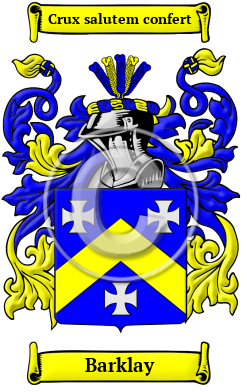
Motto: Crux salutem confert
Motto Translation: The cross brings salvation
- Lower, Mark Anthony, Patronymica Britannica, A Dictionary of Family Names of the United Kingdom. London: John Russel Smith, 1860. Print.
- Sims, Clifford Stanley The Origin and Signification of Scottish Surnames. 1862. Print.
- Black, George F., The Surnames of Scotland Their Origin, Meaning and History. New York: New York Public Library, 1946. Print. (ISBN 0-87104-172-3)
- The Political Graveyard: Alphabetical Name Index. (Retrieved 2016, January 21) . Retrieved from http://politicalgraveyard.com/alpha/index.html
 |