| ![Show Contents]() Banners History, Family Crest & Coats of Arms Banners History, Family Crest & Coats of Arms
Etymology of BannersWhat does the name Banners mean? This occupational name typically seen as Bannerman denoted someone who as a Standard Bearer, from the Middle English words banere + man and from the Old French ban(i)ere; from Latin bann-um, meaning a banner. 1 2 The first record of the family was found in Normandy in the Magni Rotuli Scaccarii Normanniae which listed Robert le Baneor, Normandy, 1180. 3 Early Origins of the Banners familyThe surname Banners was first found in Normandy about the time of the Norman Conquest c. 1066. As an occupational name for "someone who carries the banner," it denoted a person who held the office of standard-bearer to one of the early kings or one who summoned, proclaimed, heralded. By extension Bannerman was more popular in Scotland, whereas, the root Banner was more popular in England. Early History of the Banners familyThis web page shows only a small excerpt of our Banners research. The years 1782, 1865, 1870 and 1880 are included under the topic Early Banners History in all our PDF Extended History products and printed products wherever possible. Banners Spelling VariationsSpelling variations of this family name include: Banner, Bannare and others. Early Notables of the Banners familyHarmood Banner (1782-1865), a British accountant and auditor who played a major role in the development of accounting and finance in Liverpool, establishing the foundation for the Liverpool Society of Chartered Accountants 1870; which, in turn, played a...
Another 37 words (3 lines of text) are included under the topic Early Banners Notables in all our PDF Extended History products and printed products wherever possible.
| Banners migration to the United States | + |
Banners Settlers in United States in the 19th Century- John Banners, aged 22, who arrived in New York in 1854 4
- Ellen Banners, aged 20, who landed in New York in 1854 4
The motto was originally a war cry or slogan. Mottoes first began to be shown with arms in the 14th and 15th centuries, but were not in general use until the 17th century. Thus the oldest coats of arms generally do not include a motto. Mottoes seldom form part of the grant of arms: Under most heraldic authorities, a motto is an optional component of the coat of arms, and can be added to or changed at will; many families have chosen not to display a motto.
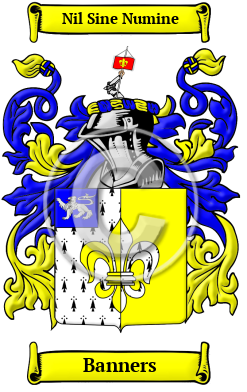
Motto: Nil Sine Numine
Motto Translation: Nothing without the Deity
- Harrison, Henry, Surnames of the United Kingdom: A Concise Etymological Dictionary Baltimore: Geneological Publishing Company, 2013. Print
- Lower, Mark Anthony, Patronymica Britannica, A Dictionary of Family Names of the United Kingdom. London: John Russel Smith, 1860. Print.
- The Norman People and Their Existing Descendants in the British Dominions and the United States Of America. Baltimore: Genealogical Publishing, 1975. Print. (ISBN 0-8063-0636-X)
- Filby, P. William, Meyer, Mary K., Passenger and immigration lists index : a guide to published arrival records of about 500,000 passengers who came to the United States and Canada in the seventeenth, eighteenth, and nineteenth centuries. 1982-1985 Cumulated Supplements in Four Volumes Detroit, Mich. : Gale Research Co., 1985, Print (ISBN 0-8103-1795-8)
 |